
Latest News
- Home
- Latest News
- Cyclone Rated Roofing Screws — What Makes Them Wind Resistant?
2025.12.08
Latest News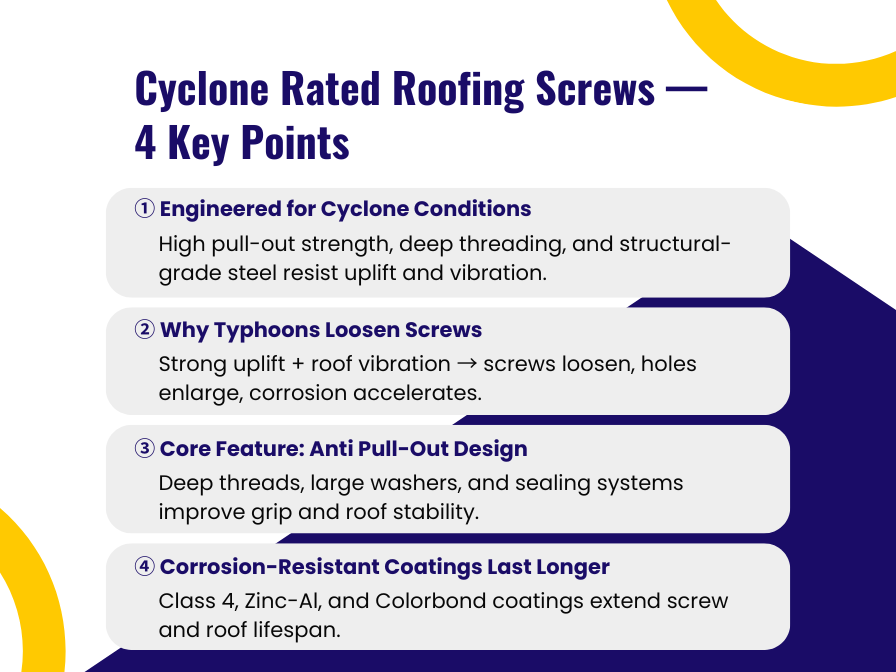
What Are Cyclone Rated Roofing Screws?
Cyclone rated roofing screws are engineered roofing fasteners designed specifically to resist uplift forces, strong wind vibrations, and pressure changes caused by severe storms. They exceed standard roof screws in strength, corrosion protection, and structural performance.
Key Features Include:
- Higher Pull-Out Strength:
Built to withstand negative pressure and uplift forces during storms. - Deep or Structural Threading:
Ensures stronger material engagement and prevents loosening. - Hardened, Structural-Grade Steel:
Improves durability and resistance to cyclical loads. - Advanced Anti-Corrosion Coatings:
Such as Zinc-Al, Class 4 coatings, or Colorbond-matched finishes.
These properties make cyclone rated roofing screws essential for coastal regions, high-wind zones, and buildings requiring enhanced long-term roof stability.
Why Do Typhoons Directly Affect Roofing Screws?
Typhoons damage roofs not just due to strong winds, but because they create upward suction, structural vibration, and repetitive loads that gradually weaken roofing fasteners.
How Typhoons Cause Fastener Failure
1. Loosening
➮ Wind vibration causes screws to slowly lose tension.
➮ Standard roof screws often lack sufficient threading depth to maintain grip.
2. Slipping
➮ Roof sheets move during storms, enlarging screw holes.
➮ Incorrect screw angles increase lateral stress and reduce holding power.
3. Corrosion
➮ Coastal salt spray rapidly corrodes unprotected screws.
➮ Rusted screws lose structural strength, often retaining only 40–70% of original capacity.
Uplift Force: Why Roofs Are “Pulled Up” During Storms
When strong winds pass rapidly over a roof, they create negative pressure above it.
Meanwhile, indoor pressure remains higher, pushing from below.
This difference produces Uplift Force, which:
-
- Pulls roof sheets upward
- Stresses each screw’s pull-out strength
- Can cause screws to loosen, bend, or break
- Ultimately may lead to roof sheets lifting or detaching
Cyclone rated roofing screws are specifically engineered to resist this uplift mechanism.
Core Feature of Wind-Resistant Screws: Anti Pull-Out Design
The primary characteristic of cyclone rated roofing screws is their ability to resist extreme uplift forces. Their threading, steel strength, and washer systems are optimized for maximum wind resistance.
Key Anti Pull-Out Design Elements
- Deep Thread Design:
➮ Maximizes surface contact
➮ Reduces loosening under vibration - High-Low or Dual Threads:
➮ Enhances shear resistance
➮ Suitable for both timber and steel battens - Hardened Steel Material:
➮ Prevents snapping during high stress
➮ Increases resistance to oscillating loads - Large Washer With Sealing System:
➮ Reduces roof sheet movement
➮ Prevents water ingress
➮ Protects screw penetration points from expansion damage
These design features collectively increase the roof’s ability to stay intact during storms.
Corrosion Resistance: Withstanding High-Salt and High-Humidity Environments
In coastal, high-humidity or industrial environments, corrosion resistance directly impacts roof lifespan. Rust weakens screw strength, making advanced coatings essential for cyclone rated roofing screws.
Why Corrosion Resistance Matters
- Salt Exposure: Standard zinc screws may rust within 1–3 years
- High Humidity: Accelerates metal fatigue
- Industrial Zones: Acidic air pollutants increase corrosion rates
Common Anti-Corrosion Coating Options
- Class 3 & Class 4 Coatings:
Designed for severe environments - Zinc-Al Alloy (Zincalume-Type Coating):
Offers 3–4× the corrosion resistance of standard galvanization - Colorbond Roofing Screws Coating:
Matches Colorbond roofing durability and UV resistance
Using screws with consistent coating quality—such as Colorbond roofing screws—helps achieve a uniform lifespan across the entire roof system.
Does Installation Quality Affect Wind Resistance?
Even the highest-grade cyclone rated roofing screws cannot perform properly if installed incorrectly. Installation quality has a direct impact on roof wind resistance.
Common Installation Errors
- Screws driven too shallow → inadequate pull-out strength
- Angled installation → increased shear force
- Missing or misaligned screws → sheet vibration and hole enlargement
- Damaged sealing washers → water ingress and corrosion
- Using incorrect screw types → insufficient structural connection
Proper Installation Checklist
- Use roofing fasteners that match roof sheet material
- Drive screws at a true perpendicular angle
- Avoid overtightening to protect sealing washers
- Ensure correct embedment depth
- Follow recommended screw spacing and pattern
Good installation ensures the wind-resistant properties of cyclone rated roofing screws are fully utilized.
Frequently Asked Questions (FAQ)
Q:Which Roofing Fasteners Are Recommended for Coastal Areas?
A:For coastal areas, cyclone rated roofing screws are recommended, ideally with Class 4 or other high-corrosion-resistant coatings. Colorbond roofing screws are also suitable, especially for homes near the coastline.
Q:What’s the Difference Between Cyclone Rated Roofing Screws and Standard Screws?
A:Cyclone rated screws have higher pull-out strength, better corrosion-resistant coatings like Class 3–4 or Colorbond, and are designed for extreme wind conditions. Standard screws have basic pull-out strength, standard zinc coating, and are more prone to loosening in high winds.
Q:Do Colorbond Roofing Screws Have to Be Used with Colorbond Roofing?
A:It is recommended because the coating matches the roof material, prevents color mismatch, ensures consistent corrosion resistance, and extends the lifespan of the roof panels.
Q:What Damage Can a Cyclone or Hurricane Cause to a Roof?
A:A cyclone or hurricane can loosen screws, lift roof sheets, cause leaks, damage structural alignment, and potentially lead to interior water damage.
Q:How to Tell If Your Roof Needs an Upgrade to Wind-Resistant Screws?
A:Check for rusted or loose screws, roof vibration during strong winds, visible sheet displacement, older roofs over 10–15 years, or roofs in high-wind or coastal zones. Any of these signs suggest it may be time to upgrade to cyclone rated roofing screws.
Further reading:
Bunnings Roof Screws vs Professional Roof Screws: Which to Use?
Sandwich Panel Screw Tips-Choosing and Installing Metal Roof Self Drilling Screws
How to Prevent Rust and Corrosion on Stitching Screws and Roofing Fasteners
How to Inspect and Avoid Over-Torqued Self Drilling Screws on Roofs
Colorbond Roofing Screws — Prevent Rust and Maintain Roof Aesthetics
Polycarbonate Roof Screws — How to Fix Sheets Without Cracking
Metal Roof Screws — Choosing the Right Seal and Washer Type
Roofing Fasteners 101 — Preventing Leaks and Corrosion