
Latest News
- Home
- Latest News
- Bunnings Roof Screws vs Professional Roof Screws: Which to Use?
2025.12.22
Latest News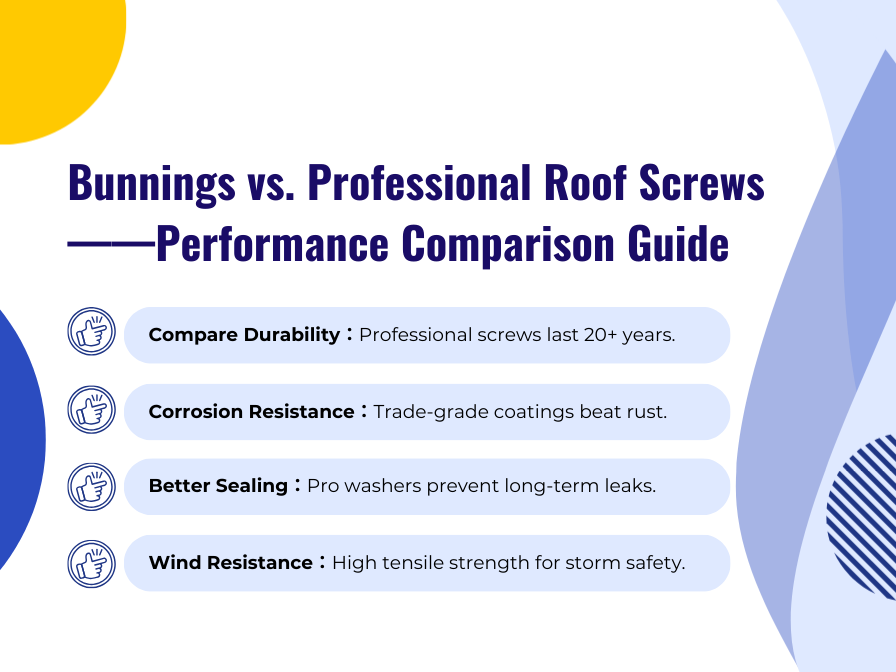
When selecting roofing fasteners, many homeowners and renovators default to Bunnings roof screws because they are easy to source and appear cost-effective. However, in professional roofing projects, fastener choice is rarely about convenience—it is about long-term performance, risk control, and total lifecycle cost.
The real question is not whether retail roof screws can hold a sheet of metal in place today, but whether they can maintain structural integrity, water tightness, and corrosion resistance over the next 20 to 30 years. This article compares Bunnings roof screws with professional-grade self drilling screws, helping you make an informed decision based on application, environment, and expected lifespan.
Why Professionals Don’t Use Standard Bunnings Roof Screws?
Professional roofers generally avoid Bunnings roof screws not because they are unusable, but because they introduce unnecessary long-term risk. Roofing professionals are responsible for waterproofing performance, wind resistance, compliance with building standards, and warranty obligations. Any fastener failure can result in costly callbacks, repairs, or liability issues.
Retail-grade roof screws are manufactured to meet general consumer needs rather than trade-level performance benchmarks. Over time, professionals frequently observe issues such as washer hardening, coating breakdown, and reduced holding strength—particularly on roofs exposed to strong UV radiation, temperature fluctuations, and wind uplift.
In contrast, professional-grade self drilling screws are selected to minimize these risks. They provide predictable performance over decades, reducing the likelihood of leaks, corrosion-related failures, and premature replacement. For professionals, paying more upfront for reliable fasteners is a cost-control strategy, not an expense.
The Three Key Characteristics of Bunnings Roof Screws
To understand where Bunnings roof screws fit, it is important to recognize how they are designed and what they are intended for.
1. Designed for Accessibility, Not Longevity
Retail roof screws are engineered for easy availability and broad compatibility. They are suitable for light-duty or short-term applications but are not optimized for roofs expected to perform for decades.
2. Adequate Corrosion Protection for Mild Conditions
Most Bunnings screws offer basic corrosion resistance suitable for inland or low-exposure environments. In coastal, industrial, or high-humidity areas, this level of protection often proves insufficient.
3. Entry-Level Sealing Systems
The washer and seal are common failure points. Many retail self drilling screws use lower-grade washers that lose elasticity over time, increasing the risk of water ingress even if the screw itself remains intact.
Five Essential Features Every Professional-Grade Roof Screw Should Have
Professional-grade roof screws are purpose-built to address the long-term stresses that roofing systems face.
1. High-Level Corrosion Resistance
Trade-grade coatings or stainless steel options are essential for preventing rust in harsh environments, especially near the coast.
2. Precision Self-Drilling Points
High-quality self drilling screws penetrate substrates efficiently, reducing heat and preserving protective coatings during installation.
3. Long-Life Sealing Washers
Professional washers retain flexibility over many years, maintaining a watertight seal despite thermal expansion and contraction.
4. Superior Pull-Out and Tensile Strength
Wind uplift is a major cause of roof failure. Professional roof screws are engineered and tested to resist significantly higher loads.
5. Consistent Manufacturing Quality
Tighter tolerances mean fewer stripped heads, better seating, and faster installation—critical for large-scale or commercial projects.
Each of these features directly reduces future maintenance costs and failure risk.
How to Choose the Right Roofing Screws for Your Project
Choosing between Bunnings roof screws and professional-grade alternatives depends on project requirements rather than price alone.
Bunnings roof screws may be suitable when:
- The structure is temporary or non-critical.
- Environmental exposure is minimal.
- Long-term performance is not essential.
Professional roof screws are strongly recommended when:
- Installing residential or commercial roofing.
- The roof is in a coastal or high-wind zone.
- Long-term warranties or compliance are required.
In many cases, using retail roof screws on permanent roofs leads to early replacement cycles, negating.
Four Critical Things to Check When Replacing Roof Screws
Replacing roof screws is often approached too narrowly, focusing only on visible rust.
1. Ignoring Washer Degradation
Even when screws appear intact, degraded washers can already be allowing moisture penetration.
2. Overlooking Substrate Damage
Corrosion around existing holes reduces holding strength and requires corrective solutions.
3. Mixing Screw Grades
Combining Bunnings roof screws with professional-grade fasteners creates uneven performance across the roof.
4. Underestimating Environmental Exposure
Using low-grade roof screws in harsh conditions almost guarantees repeated maintenance.
A comprehensive replacement strategy is usually more cost-effective than repeated partial fixes.
Frequently Asked Questions (FAQ)
Q:How Long Do Professional Roofing Screws Really Last?
A:Properly installed professional roof screws typically last 20–30 years or longer.
Q:Are Bunnings roof screws safe for coastal areas?
A:They are generally not recommended due to limited corrosion resistance.
Q:What’s the difference between retail-grade and trade-grade roofing screws?
A:Trade-grade screws offer superior coatings, washer systems, and structural performance.
Q:Can I mix different types of roof screws on the same roof ?
A:This is discouraged, as inconsistent performance can lead to leaks and uneven load distribution.
Q:Is it necessary to replace all screws if only a few are rusting?
A:In most cases, yes. Visible rust often indicates broader system degradation.
Further reading:
Top 5 Mistakes When Choosing Roofing Fasteners for Polycarbonate Roofs
How to Fix Polycarbonate Roofing:Step-by-Step Leak-Proof Guide
How to Choose Polycarbonate Thickness? Roof Material Guide
Stop Skylight Leaks during rainy days
Sandwich Panel Screw Tips-Choosing and Installing Metal Roof Self Drilling Screws
How to Prevent Rust and Corrosion on Stitching Screws and Roofing Fasteners
How to Inspect and Avoid Over-Torqued Self Drilling Screws on Roofs