
Latest News
- Home
- Latest News
- Top 5 Mistakes When Choosing Roofing Fasteners for Polycarbonate Roofs
2026.01.07
Latest News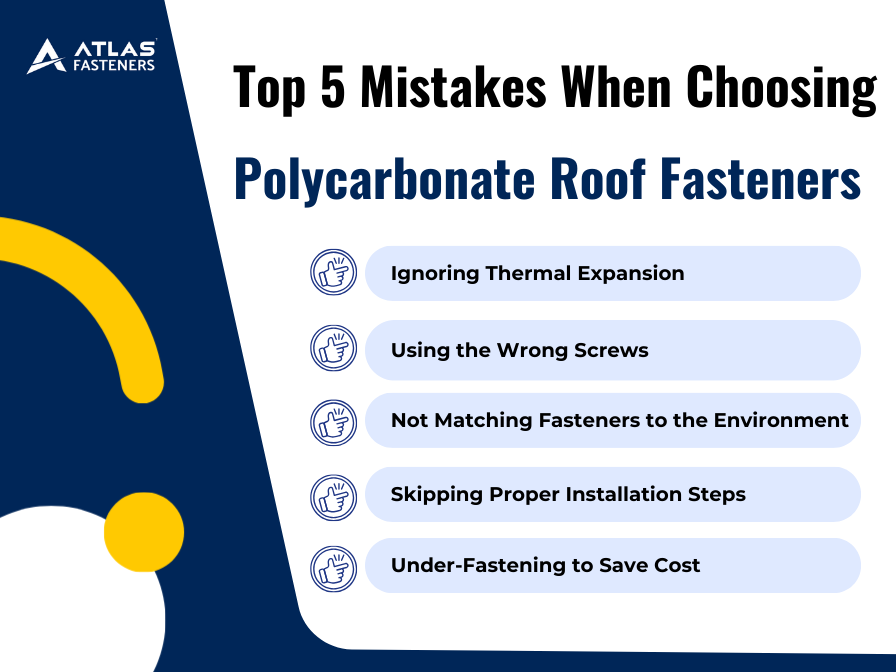
Choosing the right polycarbonate roof fasteners is just as critical as selecting high-quality PC sheets. Many installation failures—cracking, leaks, noise, or premature aging—are not caused by the polycarbonate itself, but by incorrect polycarbonate roof screws or improper fastening methods.
This article outlines the most common mistakes and explains how to select suitable roofing fasteners for long-term performance.
Characteristics of Polycarbonate (PC) Sheets
Polycarbonate sheets are widely used for roofing, skylights, canopies, and greenhouses due to their outstanding properties:
- High impact resistance (up to 250× stronger than glass)
- Lightweight yet structurally strong
- UV-resistant (with proper coating)
- High thermal expansion rate
Among these, thermal expansion is the most critical factor affecting fastener selection. PC sheets expand and contract significantly with temperature changes. If fasteners do not accommodate this movement, stress concentration will occur, leading to cracking around screw holes or long-term deformation.
Mistake #1: Treating polycarbonate like metal or wood and ignoring thermal movement.
Special Design of Polycarbonate Roof Screws
Unlike standard screws, polycarbonate roof screws are engineered specifically for plastic materials. Key design features include:
-
EPDM or neoprene washers
Provide waterproof sealing and absorb thermal movement. -
Corrosion-resistant materials
Australian standard class 4 coating for superior outdoor durability.
Using ordinary screws often results in uneven pressure, water leakage, or UV-degraded rubber washers.
Mistake #2: Using general wood screws or metal self-tapping screw
How to Choose the Right Roofing Fasteners for Your Environment
Environmental conditions should directly influence your fastener choice:
| Environment | Recommended Fastener Features |
| Coastal / High humidity | 304 or 316 stainless steel |
| High UV exposure | UV-stabilized EPDM washers |
| High-wind zones | Larger washers, closer spacing |
| Industrial / polluted areas | Anti-corrosion coatings |
Additionally, fastener length must match the total thickness of:
- PC sheet
- Spacer (if any)
- Supporting structure
Mistake #3: Choosing fasteners based only on price, not environment.
Pre-Installation Checklist: What You Need Besides Screws
Successful installation depends on more than just screws. Before installation, confirm the following:
- Pre-drilled holes (larger than screw diameter)
- Correct drill bit for plastics (to avoid chipping)
- Torque-controlled tools or low-speed drivers
- Compatible sealing washers
- Proper support spacing per sheet thickness
Skipping these steps often causes irreversible damage during installation.
Mistake #4: Installing without pre-drilling or torque control.
How to Calculate the Number of Fasteners Needed
Fastener quantity depends on wind load, sheet thickness, and support spacing. General guidelines:
- Edge areas: 1 fastener every 300–400 mm
- Central areas: 1 fastener every 400–600 mm
- High-wind zones: Reduce spacing by 20–30%
Always follow the sheet manufacturer’s technical manual for structural compliance.
Mistake #5: Under-fastening to save time or cost.
Frequently Asked Questions (FAQ)
Q:Can I use wood screws or regular self-tapping screws to fix PC sheets?
A:No. Standard screws lack stress-relief design and proper sealing washers, increasing the risk of cracking and leakage.
Q:How tight should the screws be installed to meet the standard?
A:Screws should be snug, not compressed. The washer should sit flat without deformation. Over-tightening restricts thermal movement and causes stress fractures.
Q:Should the pre-drilled hole always be larger than the screw?
A:Yes. The hole should be 2–3 mm larger than the screw diameter to allow for thermal expansion and contraction.
Q:In high-wind areas, do I need to use special fasteners?
A:Yes. High-wind regions require corrosion-resistant screws, larger washers, and closer fastener spacing to prevent uplift and vibration.
Q:I’ve already bought high-quality PC sheets, so why should I spend more on specialized screws?
A:Because fasteners directly affect structural integrity and lifespan. Using incorrect screws can negate the benefits of premium polycarbonate sheets and lead to costly repairs or replacements.