
Latest News
- Home
- Latest News
- How to Fix Polycarbonate Roofing:Step-by-Step Leak-Proof Guide
2026.01.07
Latest News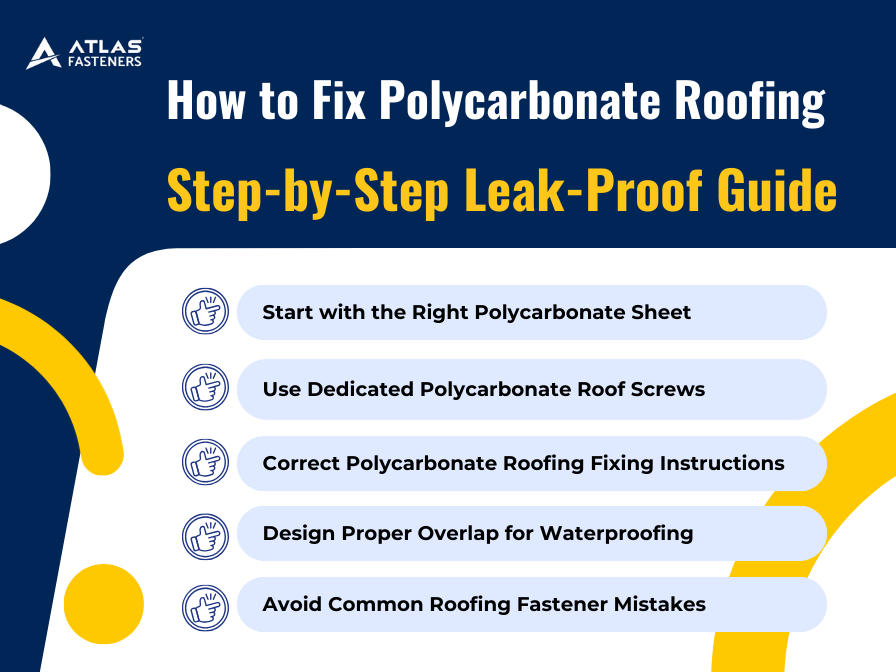
Polycarbonate roofing has become a mainstream solution in residential, commercial, and industrial construction. From patios and carports to warehouses and agricultural structures, its popularity is driven by high impact resistance, excellent light transmission, and long service life.
However, many roof failures are not caused by the material itself, but by incorrect polycarbonate roofing fixing instructions being followed during installation. Using improper polycarbonate roof screws or unsuitable roofing fasteners often results in leaks, cracking, or premature deformation. Understanding the correct installation logic is therefore critical for long-term performance.
How to Choose Polycarbonate Corrugated Sheets
Selecting the right polycarbonate sheet is the foundation of a leak-proof roof.
Key technical considerations include:
- UV-protected side:
High-quality sheets have a co-extruded UV layer. Installing the sheet upside down will significantly reduce lifespan.
- Thickness and profile:
Corrugated sheets typically range from 0.8 mm to 1.2 mm. Thicker sheets offer better rigidity and wind resistance.
- Thermal expansion coefficient:
Polycarbonate expands and contracts more than metal. This must be accounted for in both sheet layout and fastening design.
Ignoring these factors often leads to stress cracking around fastener points, even when premium roofing fasteners are used.
How to Select the Right Roofing Fasteners
Fastener selection is one of the most underestimated aspects of polycarbonate roofing installation.
Best practices include:
- Use dedicated polycarbonate roof screws:
These are typically stainless steel or coated carbon steel, designed to resist corrosion and structural fatigue.
- EPDM or silicone washers:
Washer material matters. EPDM washers provide superior weather resistance and elasticity, maintaining a watertight seal despite thermal movement.
- Avoid generic wood or self-tapping screws:
These lack proper thread geometry and often over-compress the sheet, leading to cracks.
Correct roofing fasteners are not an accessory—they are a structural component of the roofing system.
5 steps Polycarbonate Roofing Fixing Instructions
Following professional polycarbonate roofing fixing instructions significantly reduces failure risk.
Step 1: Pre-drilling
Drill holes 2–3 mm larger than the screw diameter to allow for thermal expansion.
Step 2: Fastener positioning
Fix screws at the crest of corrugation, not the valley, to prevent water pooling.
Step 3: Controlled tightening
Do not overtighten. The washer should be snug, not compressed flat.
Step 4: Sheet overlap design
- Side overlap: at least one corrugation
- End overlap: 150–200 mm depending on roof pitch
Step 5: Allow movement clearance
Never force sheets into rigid alignment. Expansion space is essential for durability.
Common Installation Mistakes: Why Your Roof Might Leak
Most leakage issues can be traced back to predictable errors:
- Using incorrect polycarbonate roof screws without sealing washers.
- Drilling holes after sheet placement, causing stress fractures.
- Installing sheets too tightly with no expansion allowance.
- Inadequate overlap in high-rainfall or windy environments.
These mistakes often appear months after installation, leading to costly rework and customer dissatisfaction.
Frequently Asked Questions (FAQ)
Q:Can I use regular wood screws instead of specialized polycarbonate roof screws?
A:No. Wood screws lack sealing washers and appropriate thread design, increasing the risk of cracking and leaks.
Q:Which side of the sheet should face the sun during installation?
A:The UV-protected side must face outward. Most sheets are labeled or printed for identification.
Q:Why should the drilled hole be 2–3 mm larger than the screw?
A:Polycarbonate expands with temperature changes. Oversized holes prevent stress fractures.
Q:How much overlap should corrugated sheets have to ensure safety?
A:At least 1.5 corrugation on the side, and 150-200 mm when joining length-wise.
Q:Does the material of screw washers make a difference?
A:Yes. EPDM washers outperform PVC or rubber in UV resistance and long-term sealing.