
Latest News
- Home
- Latest News
- Sandwich Panel Screw vs Stitching Screws: Roofing Fasteners Guide
2025.10.08
Latest News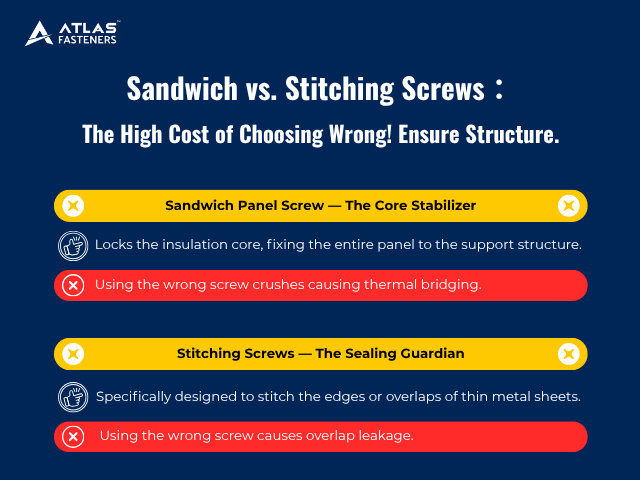
In modern metal roofing and sandwich panel construction, selecting the right roofing fasteners is critical for durability and structural stability. Whether for industrial factories, warehouse roofs, or residential metal roofs, using the wrong screws can cause leaks, thermal bridging, and even structural damage. This article provides a detailed analysis of the features, applications, and professional installation methods for sandwich panel screws and stitching screws, helping contractors and architects make the right choices.
Design Features of Sandwich Panel Screws and Compatibility with Sandwich Panels
Sandwich panel screws are specifically designed for sandwich panels, typically featuring a self-drilling tip that can penetrate the metal face sheets while securely holding the insulating core without damaging the structure. Key design features include:
- Self-drilling tip: Can penetrate both the top and bottom sheets along with the insulation core, reducing the need for pre-drilling
- Large head design: Increases contact area to distribute pressure and prevent compression of the insulation laye
- Corrosion-resistant coating: Usually galvanized or stainless steel, suitable for outdoor environments
These screws are widely used in industrial buildings, cold storage facilities, warehouses, and sandwich panel roof installations, ensuring structural stability and long-term durability.
Installation Methods to Prevent Thermal Bridging
Improper installation of metal sandwich panels can create thermal bridges, reducing insulation effectiveness. Professional installation recommendations include:
- Use of thermal washers: Minimizes direct metal contact, reducing heat transfer
- Correct torque: Over-tightening can crush the insulation layer, while under-tightening compromises holding strength
- Even spacing: Distribute screws evenly to maintain overall panel stability
Following these guidelines maximizes insulation performance and minimizes energy loss when installing sandwich panel screws.
Common Sizes and Materials
The material and dimensions of screws directly affect roof durability and corrosion resistance:
| Screw Type | Common Material | Size Range | Features |
| Sandwich panel screw | Carbon steel / Stainless steel / Galvanized | M6–M8, length 40–150mm | Suitable for penetrating metal sheets and insulation cores, high weather resistance |
| Stitching screws | Carbon steel / Stainless steel | M5–M6, length 20–60mm | Self-drilling screws for securing thin metal sheets, fast installation |
Professional contractors should select the appropriate specifications based on roof structure, panel thickness, and environmental conditions to ensure roofing fasteners perform optimally.
Differences Between Stitching Screws and Self-Drilling Screws & How to Use Them Together
Stitching screws are used to secure thin metal panels or roof cladding, often at overlaps. Compared to self-drilling screws:
-
Self-drilling screws: Can penetrate panels directly, providing strong fixation, suitable for single sheets
-
Stitching screws: Ideal for thin panel overlaps, keeping surfaces flat and minimizing protrusions
In roofing projects, sandwich panel screws are typically used to secure main panels first, followed by stitching screws at overlaps to improve structural stability and waterproofing.
Structural Comparison: Sandwich Panel Screws vs Stitching Screws
| Feature | Sandwich Panel Screw | Stitching Screws |
| Application | Secures entire sandwich panel | Secures thin metal sheet overlaps |
| Penetration | High, can penetrate insulation core | Medium, mainly fixes thin sheets |
| Head Design | Large head distributes pressure | Small, flat head |
| Installation Location | Center of panel or support points | Panel overlaps |
Using both types of screws appropriately balances structural stability, insulation performance, and installation efficiency.
Frequently Asked Questions (FAQ)
Q: Will sandwich panel screws damage the insulation core?
A: No, provided the correct screw size is used with washers and torque is properly controlled.
Q: How do roofing fasteners differ from regular screws?
A: Professional roofing fasteners are designed for roofing panels and waterproofing needs. They are corrosion-resistant, prevent loosening, and have a longer service life than regular screws.
Q: How to choose the right screws for metal roofs?
A: Consider panel thickness, sandwich structure, environmental conditions (indoor/outdoor), corrosion protection, and screw length.
Q: How often should roof screws be replaced?
A: Depends on material and environment. Carbon steel screws last 5–10 years, while stainless steel or galvanized screws can last 15–20 years. Regularly check for loosening or corrosion.
Q: Can sandwich panel screws and stitching screws be used interchangeably?
A: Not recommended. They serve different functions, and swapping them could result in loose fixing or damage to the insulation layer.
Q: When should stitching screws be used?
A: Use stitching screws at panel overlaps, thin metal sheets, or areas requiring a flat surface to ensure structural stability and waterproofing.
For metal roofing and sandwich panel projects, selecting the right sandwich panel screws and stitching screws and installing them correctly is crucial for durable, waterproof, and structurally sound roofs. Contractors and architects should choose the appropriate specifications and materials for roofing fasteners based on panel thickness, environmental conditions, and structural requirements.
If you are planning industrial, warehouse, or residential metal roofing projects and need high-quality screws, professional installation guidance, or wholesale supply, contact us today. We provide comprehensive technical support to enhance construction efficiency, reduce maintenance costs, and ensure every roof panel is securely installed.
Further reading:
How to Choose the Right Stitching Screws for Metal Roof Strengthening
Tired of Loose Metal Fixes? Use Heavy Duty Tek Self-Drilling Screws!
How to Use Self Drilling Screws and Collated Screws
Differences Between Tek Screws and Self Drilling Screws for Metal & Heavy Duty Installation Tips