
Latest News
- Home
- Latest News
- Type 17 Timber, Bugle & Plasterboard Screws Overview
2025.09.15
Latest News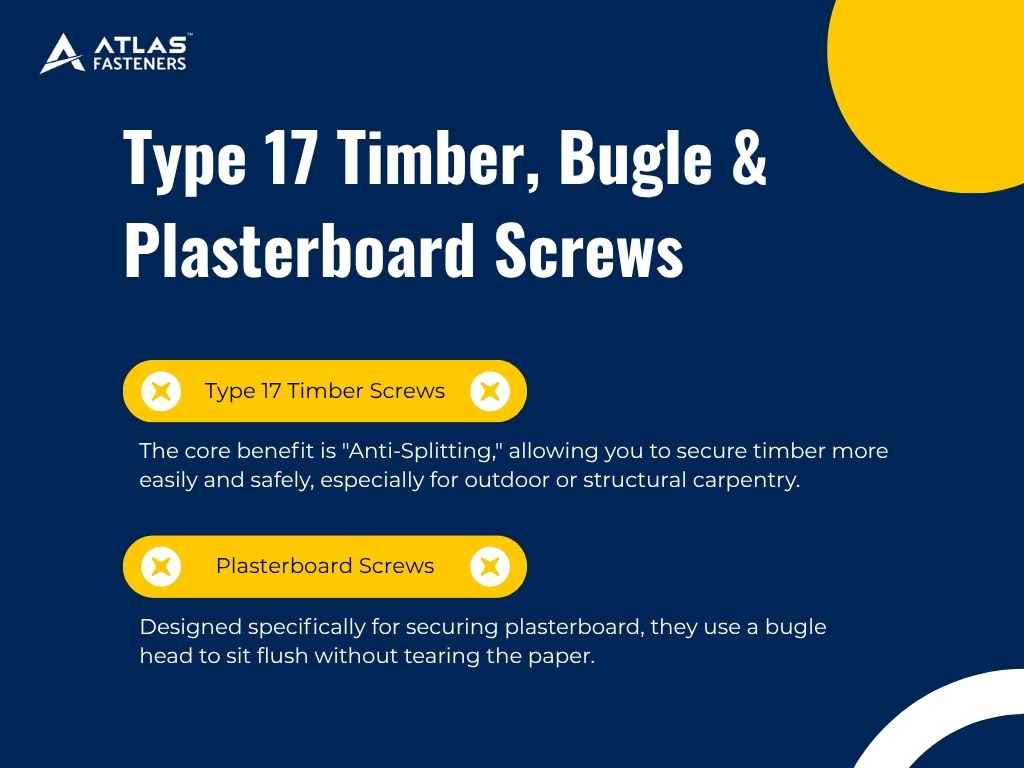
In construction and interior fit-outs, different types of screws have their own specific applications and design features. For woodworking, plasterboard installation, and partition framing, the three most commonly discussed are type 17 timber screws, bugle screws, and plasterboard screws. While they may look similar at first glance, they differ significantly in material, size, usage, and installation techniques. This guide will walk you through each type so you can choose the right screw for the job every time.
The Anti-Splitting Advantage of Type 17 Timber Screws
The standout feature of type 17 timber screws is their cut-point tip (Type 17 Cut Point). This design allows the screw to cut its own path into the timber, reducing driving resistance and minimizing the risk of wood splitting.
- Material and Coating: Commonly available in zinc-plated carbon steel or stainless steel. Stainless steel is especially suitable for outdoor or high-moisture environments.
- Applications: Timber framing, decking, outdoor pergolas, wooden flooring, and general carpentry.
- Installation Tip: Often no pilot hole is required, but for hardwoods or thin timber, pre-drilling can help achieve the best results.
What’s the Difference Between Plasterboard Screws and Bugle Screws?
Many people confuse plasterboard screws with bugle screws.
- Plasterboard screws: Specifically designed for securing plasterboard (drywall). They feature a bugle head that sinks flush with the board without tearing the paper face.
- Bugle screws: Refers to any screw with a bugle-shaped head. They are not limited to plasterboard applications. In other words, all plasterboard screws are bugle head screws, but not all bugle screws are plasterboard screws.
Plasterboard Screws – For Metal or Timber Framing?
Plasterboard screws are available in two thread types:
- Fine Thread: Best for steel stud frames; the tighter pitch bites securely into metal.
- Coarse Thread: Best for timber studs; the wider pitch quickly cuts into and grips wood fibres.
Choosing Between Coarse Thread and Fine Thread – On-Site Judgement
Here’s a quick way to decide:
- If the stud is magnetic → it’s metal → choose fine thread.
- If it’s solid wood or plywood → choose coarse thread.
If unsure, bring both types to the site and test for driving feel and holding strength.
Frequently Asked Questions (FAQ)
Q: Can type 17 timber screws be used outdoors? Will they rust?
A: Yes, but choose stainless steel or hot-dip galvanized versions to prevent corrosion in wet or humid conditions.
Q: Do bugle screws have to be used with plasterboard?
A: Not necessarily. The bugle head design is also suitable for timber, plywood, and outdoor treated wood applications.
Q: For DIY wall hanging, should I use plasterboard screws or wall plugs?
A: If the wall is plasterboard and you’re hanging a heavy object, a dedicated plasterboard wall plug or anchor will be more secure.
Q: Do type 17 timber screws require a pilot hole?
A: In softwood, they can be driven directly, but in hardwood or thin timber, pre-drilling will help prevent splitting.
Q: Are plasterboard screws suitable for bathrooms or wet areas?
A: Standard carbon steel screws are not ideal; use corrosion-resistant coated or stainless steel versions with moisture-resistant plasterboard.
Further reading:
Tek Screws: Match Drill Point & Wing to Metal Gauge for Strength