
Latest News
- Home
- Latest News
- Polycarbonate Roofing: Install It Right from Start to Finish
2025.09.01
Latest News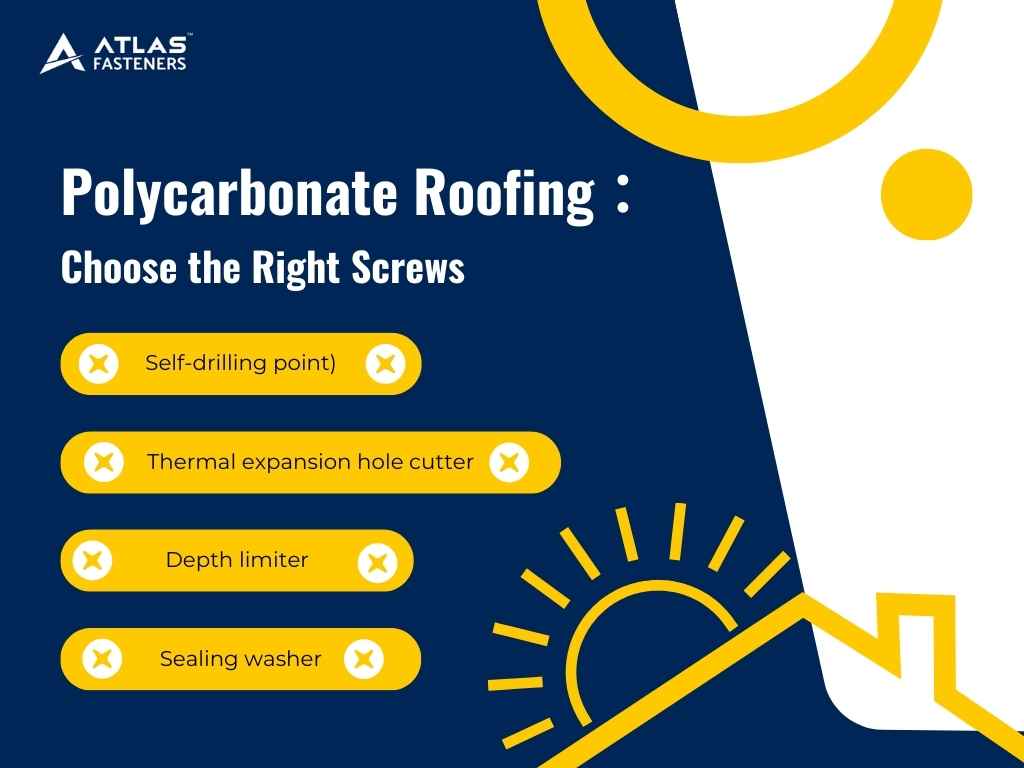
What Screws Are Suitable for Polycarbonate Roofing?
Polycarbonate sheets expand and contract with temperature change, so the fixings must allow for this thermal movement. Some of the best polycarbonate roofing screws on the market feature:
- Self-drilling point: For clean and fast installation into metal substrates.
- Type 17 (T17) sharp point: For fixing polycarbonate skylights to wooden substrates.
- Self-Drilling (SD) point: For fixing polycarbonate skylights to metal substrates.
- Thermal expansion hole cutters: Thermal expansion hole cutters that are either integrated or as a separate attachment are most common. This would eliminate the need to pre-drill a larger hole.
- Depth limiters: To prevent deformation of the sheets when the screws are overdriven.
- Sealing washers: To fully cover the thermal expansion hole, sealing it off from the elements, and should also provide vibration absorption.
One excellent example is the Kwik-Shot™ series by ATLAS FASTENERS, with versions for fixing onto either timber and metal substrates, and are pre-installed with our proprietary thermal expansion hole cutter and domed EPDM sealing washer.
Preparing for Polycarbonate Roofing Installation
Inspect and Prepare the Supporting Framework
Ensure the supporting timber or metal framing is:
- Clean, dry, and free of rust or warping
- Structurally aligned and properly spaced (typically 600mm–1000mm span depending on sheet thickness)
Cutting and Handling Polycarbonate Sheets
- Always use a fine-tooth circular saw or jigsaw.
- Avoid rough edges that could crack under stress.
- Remove protective film only after installation.
- Store sheets flat in shaded areas to avoid premature UV exposure.
Proper Method to Install Polycarbonate Sheets
Positioning and Aligning the Panels
- Lay the sheets with the UV-protected side facing upward (usually marked)
- Allow for 2–3mm of space between sheets for thermal expansion
Drilling Holes and Fixing with Screws
- Pre-drill 11mm diameter holes if using standard metal sheet screws (or use fasteners like Kwik-Shot™ with built-in hole cutters)
- Align the hole over framing and fasten using polycarbonate roof fasteners with EPDM washers that are large enough to cover the larger thermal expansion hole.
Connecting Multiple Panels
- Follow the manufacturer’s sheet overlap and fastening schedule instructions for polycarbonate corrugated profiles.
- Use H-profile connectors or specifically designed glazing bars for joining polycarbonate hollow profiles.
- Seal joints with neutral-cure silicone if necessary (avoid solvent-based products that can damage PC)
Securing the Polycarbonate Roof
Fastener and Washer Installation
- A general rule of thumb is to fasten at least 7 screws per linear meter, or every 300–500mm, depending on the local wind and snow conditions.
- Depending on the profile, edge purlins are secured at every second corrugation crest, and internal purlins, every third corrugation crest, and also on every crest overlap.
- Do not overtighten; the EPDM washer should compress just enough to follow the contour of the corrugation without becoming distorted.
- Choose Class 4 rated screws for maximum corrosion resistance
Sealing and Gaps
- Seal ridge and valley gaps with infill foam fillers or compatible flashings
- Use breathable tape for ends to prevent moisture and dust ingress while allowing ventilation
FAQ Q&A
Q: How do I fix a hole in polycarbonate roofing?
A: Use a polycarbonate patch or replace the panel if the damage is extensive. Ensure overlap and seal with neutral cure silicone.
Q: How do I drill holes in polycarbonate panels?
A: Use a step drill bit or pre-integrated expansion cutter fasteners like Kwik-Shot™. Avoid high-speed drilling that can melt edges.
Q: What to do with sharp edges after cutting or drilling?
A: Smooth the edges with fine sandpaper to prevent cracking and improve safety during handling.
Q: Why should the hole diameter be larger than the screw?
A: To accommodate thermal expansion of polycarbonate. A typical clearance of 2–3mm is needed.
Q: How tight should the screws be?
A: Just enough to hold the sheet in place without distorting it. The washer should sit flush and slightly compressed.
Q: What to do with sharp edges after cutting or drilling?
A: Smooth the edges with fine sandpaper to prevent cracking and improve safety during handling.
Further reading:
Prevent Skylight Leaks: Install Plastic Corrugated & Polycarbonate Roofs
Polycarbonate Roofing Tips for Pergolas and Greenhouses
How to Build a Green House: Roof Materials and Wind Resistance Guide
Polycarbonate Roofing: Install It Right from Start to Finish