
Latest News
- Home
- Latest News
- Self-Drilling Screws vs Self-Tapping Screws — Key Differences
2025.11.17
Latest News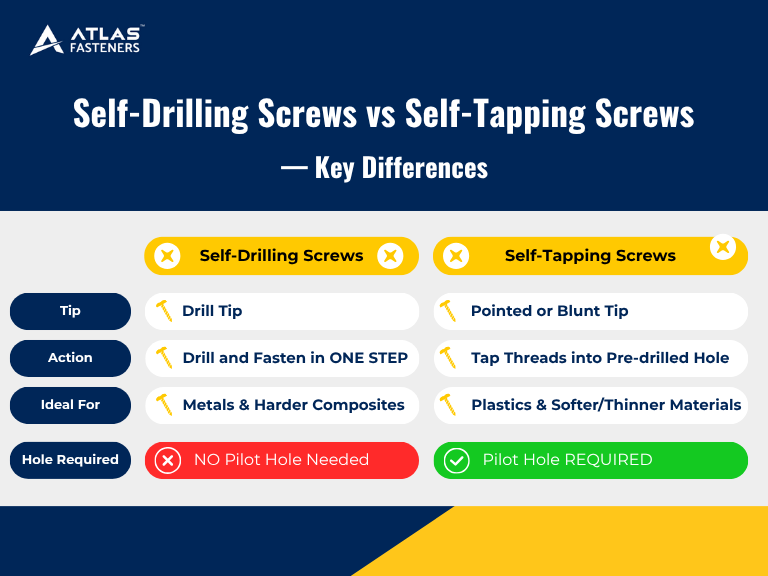
When it comes to fastening materials efficiently, choosing the right type of screws is essential. Two commonly used fasteners in construction and manufacturing are self-drilling screws and self tapping screws. While they may appear similar, their design, functionality, and applications differ. Understanding these differences ensures secure, efficient, and long-lasting installations.
What Are Self-Drilling Screws?
Self-drilling screws are screws with a drill-shaped tip that allows them to penetrate materials without the need for pre-drilling. Also known as tek screws, they can create their own hole and thread simultaneously, making them highly efficient for metal, wood, and composite materials. Their design minimizes installation time and reduces the risk of material damage, making them a favorite in professional construction and manufacturing.
What Are Self-Tapping Screws?
Self tapping screws require a pre-drilled hole. Once inserted, the screw threads cut into the material, creating their own internal threading. They are commonly used in softer materials such as plastics, thin metals, and wood, where a pre-drilled pilot hole ensures proper alignment and reduces the risk of cracking or splitting the material.
Structural Differences
The primary structural difference lies in the tip and threading:
- Self-drilling screws: Feature a drill-shaped tip, which eliminates the need for a pilot hole. The threading starts immediately behind the tip to grip the material as it drills.
- Self-tapping screws: Have a pointed or blunt tip but require a pilot hole. The threading cuts into the pre-drilled hole to create a secure hold.
Head types, thread pitch, and material coatings may vary in both screws depending on the application.
Advantages and Disadvantages
Self-Drilling Screws
- Advantages: No pilot hole needed, faster installation, strong hold, ideal for metal-to-metal and metal-to-wood applications.
- Disadvantages: Generally more expensive, may not be suitable for very soft materials.
Self-Tapping Screws
內文
- Advantages: Can be used on softer materials, flexible thread designs, lower cost.
- Disadvantages: Requires pre-drilled holes, longer installation time, less efficient for hard metals.
Frequently Asked Questions (FAQ)
Q: What are the most common types of screws for metal?
A: Self-drilling screws and self tapping screws are widely used for metal applications, with self-drilling screws preferred for thicker or harder metals.
Q: Can self-drilling screws replace self-tapping screws?
A: In many metal applications, yes, but self-tapping screws may still be needed for softer materials or specific alignment requirements.
Q: How do I prevent screw stripping?
A: Use the correct screw size, match the driver bit to the screw head, and apply steady pressure during installation.
Q: Are self-drilling screws and tek screws the same thing?
A: Yes, tek screws are a brand-name term commonly used interchangeably with self-drilling screws.
Q: How do I choose the right screw size and type?
A: Consider material thickness, type of material, load requirements, and whether a pilot hole is needed to select the appropriate screw.
Further reading:
Type 17 Timber Screws: Ideal Choice for Wood Applications
Collated Screws Explained — Faster Installation, Less Effort