
Latest News
- Home
- Latest News
- Type 17 Timber Screws: Ideal Choice for Wood Applications
2025.11.24
Latest News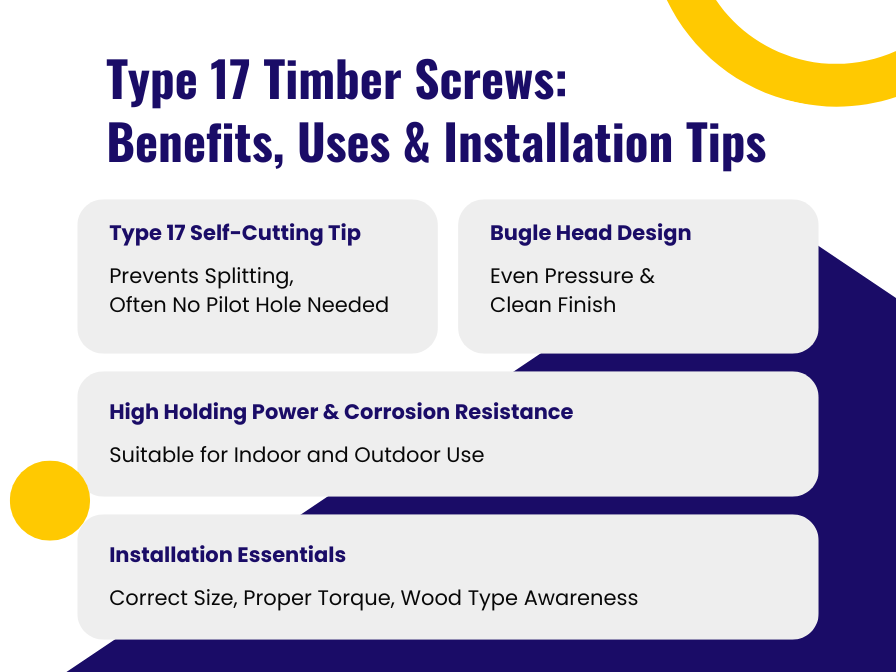
What Are Type 17 Timber Screws?
Type 17 timber screws are high-performance fasteners specifically designed for woodworking projects. Compared to standard timber screws, they offer significant advantages in terms of functionality and ease of installation. Their core feature is the Type 17 tip, which allows the screw to cut its own path into wood, reducing the risk of splitting and improving installation efficiency.
- Self-cutting tip: Smoothly penetrates both hardwoods and softwoods, minimizing wood splitting.
- Variety of sizes: Available in multiple lengths and diameters for different woodworking applications.
- Corrosion resistance: Often zinc-plated or phosphated for indoor and outdoor use.
- Aesthetic bugle head: Sits flush or slightly below the wood surface for easier finishing and painting.
Using Type 17 timber screws not only reduces errors during installation but also ensures strong and durable wood connections. They are ideal for furniture making, carpentry, interior woodworking, or DIY projects, combining efficiency, durability, and visual appeal. Professionals and hobbyists alike can rely on these screws for consistent, high-quality results.
Type 17 timber screws|Design Features and Advantages
The design of Type 17 timber screws takes woodworking needs into account, providing multiple advantages that make them superior to standard timber screws.
- Type 17 tip: Cuts its own path into wood, often eliminating the need for pilot holes and reducing the risk of splitting.
- Optimized threads: Provide a secure grip by tightly engaging the wood fibers, increasing holding power and load capacity.
- Bugle head design: Tapered head distributes pressure evenly, preventing dents in softwoods and allowing for smooth sanding and finishing.
- Durability: Made from high-quality steel and often coated for corrosion resistance, suitable for both indoor and outdoor applications.
Additionally, Type 17 timber screws offer high installation efficiency, adaptability to various wood densities, and long-term reliability. They are engineered to ensure structural integrity, fast and easy installation, and a clean, professional finish, making them a trusted choice for both professionals and DIY enthusiasts.
Applications of Type 17 Timber Screws
Type 17 timber screws are highly versatile and suitable for a wide range of woodworking applications, from decorative to structural projects.
-
Furniture assembly: Cabinets, desks, chairs, shelves, and other wood products.
-
Interior woodworking: Partition walls, ceilings, wooden panels, and decorative frames.
-
Outdoor structures: Decking, fences, pergolas, and garden structures; corrosion-resistant screws withstand moisture and UV exposure.
-
Heavy-duty woodworking: Thick boards or beams requiring high torque and strong holding power.
These applications demonstrate that Type 17 timber screws excel in both durability and aesthetics. The bugle screws head ensures that the screw sits flush with the wood surface, simplifying sanding and finishing while maintaining a polished, professional look.
Installation Tips for Timber Screws
Proper installation of Type 17 timber screws is key to maximizing performance and avoiding common problems.
-
Select the right size: Choose the screw length and diameter according to wood thickness and joint type.
-
Determine if pre-drilling is needed: Softwoods and small screws may not require pilot holes; hardwoods and larger screws should be pre-drilled to prevent splitting.
-
Use appropriate tools: Drill or screwdriver with depth stop ensures bugle screws sit flush.
-
Apply even pressure: Avoid over-tightening or under-tightening to maintain joint strength.
-
Maintain consistent spacing: Follow recommended intervals for optimal load distribution and structural stability.
-
Outdoor protection: Use corrosion-resistant screws to extend the lifespan of outdoor wooden structures.
Following these tips ensures that Type 17 timber screws provide strong, durable, and aesthetically pleasing connections in all woodworking projects.
Common Mistakes to Avoid
Even high-quality Type 17 timber screws can underperform if installed incorrectly.
-
Ignoring wood type: Hardwoods require pilot holes; failure to pre-drill may cause splitting.
-
Over-tightening or under-tightening: Over-tightening can strip threads or damage wood, while under-tightening reduces joint strength.
-
Incorrect screw size: Screws that are too short do not hold securely, while screws that are too long may protrude through the wood.
-
Neglecting corrosion protection: Outdoor applications without corrosion-resistant screws may lead to rust and reduced lifespan.
By avoiding these mistakes, users can ensure that Type 17 timber screws deliver maximum stability, durability, and a clean finish in all wood projects.
Frequently Asked Questions (FAQ)
Q:What is the difference between Type 17 timber screws and regular timber screws?
A:Type 17 timber screws have a self-cutting tip that reduces splitting and often eliminates the need for pilot holes, while regular timber screws typically require pre-drilling and are less efficient in installation.
Q:What are the benefits of bugle head screws?
A:Bugle screws sit flush or slightly below the wood surface, evenly distribute pressure, prevent dents, and allow for smooth sanding and painting.
Q: Do I need to pre-drill holes?
A:Softwoods and small screws may not require pilot holes; hardwoods or larger screws should be pre-drilled to avoid splitting.
Q:Are they suitable for outdoor wooden structures?
A:Yes, corrosion-resistant Type 17 timber screws are ideal for decking, fences, pergolas, and other outdoor wood structures.
Q:How do I choose the appropriate screw length and diameter?
A:Choose screw length and diameter based on wood thickness and joint type, ensuring secure fastening without protruding through the wood.