
Latest News
- Home
- Latest News
- Collated Screws Explained — Faster Installation, Less Effort
2025.11.24
Latest News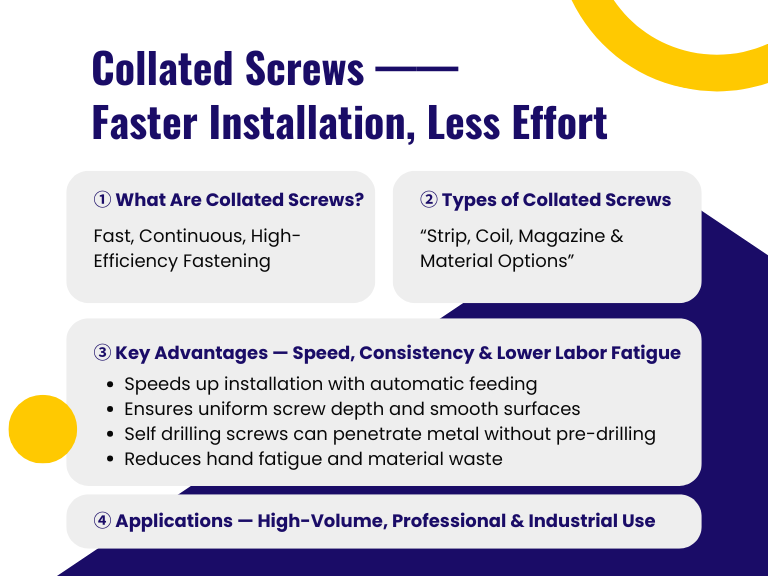
What Are Collated Screws?
Collated screws are multiple screws connected in a strip using paper tape, plastic tape, nylon wire, or magazine-style arrangements. They are designed for use with collated screw guns or automatic feeding tools, allowing users to install screws quickly and continuously without manually picking up individual screws, significantly improving work efficiency.
Key Features and Benefits
-
Multiple strip types: Paper tape, plastic tape, nylon wire, and magazine-style arrangements, chosen based on the tool used to prevent jamming or dropped screws.
-
Faster installation: Automatic feeding tools deliver the next screw continuously, increasing installation speed by 3–5 times compared to manual methods.
-
Wide material compatibility: Some collated screws are designed as self drilling screws, capable of penetrating wood, aluminum, or metal sheets without pre-drilling.
-
Consistent and stable fastening: Coupled with appropriate tools, each screw is installed at the same depth, reducing protruding screws or material cracking.
-
Reduced screw loss: The collated design prevents screws from falling or being lost, reducing material waste, especially in large projects.
Overall, collated screws are not just a screw arrangement method—they are a systematic solution for faster, more accurate, and safer installations, ideal for professional teams and high-volume projects.
Types of Collated Screws
Collated screws come in a variety of types depending on the tool, material, and application requirements. Choosing the right type ensures higher efficiency and avoids installation problems.
By Arrangement
-
Strip Collated: 20–50 screws per strip, commonly used in woodworking or drywall projects, easily fed into tools.
-
Coil Collated: Screws arranged in a coil, 100–1,000 screws per roll, suitable for high-speed, continuous installation, such as metal framing.
-
Magazine Collated: Designed for specific tools, enabling rapid, continuous installation, often used in large construction sites or industrial production lines.
By Thread and Tip Type
-
Wood Screws: Designed for wooden materials, providing optimal grip.
- Drywall Screws: Specifically for drywall and partition walls, ensuring smooth, flat surfaces.
-
Self Drilling Screws: Can penetrate metal or aluminum without pre-drilling.
-
Metal Screws: Suitable for thin steel or metal components.
By Head Type and Drive
-
Phillips, Hex, Torx
-
Flat / Pan / Round Head: Choose depending on the application to avoid stripping or damaging materials.
Choosing the correct type of collated screws ensures installation efficiency, fastening stability, and safety.
Advantages of Using Collated Screws
Collated screws are suitable for a wide range of materials and installation scenarios, especially where high-volume screw installation is required.
-
Drywall Installation: Perfect for ceilings and partition walls, enabling fast, continuous screw placement with uniform depth.
-
Woodworking: Floors, wooden walls, and furniture projects benefit from collated wood screws for increased efficiency.
-
Metal Framing: Steel frames, aluminum panels, and thin metal sheets can be fastened quickly using self drilling screws without pre-drilling.
-
Commercial Renovation and Large Projects: Light steel frames, partition walls, and ceilings can be installed quickly and consistently.
-
Industrial Production and Storage Equipment: Supports high-volume, standardized fastening, maintaining quality and efficiency.
Using the correct collated screws with compatible tools ensures fast, safe, and reliable installation across all scenarios.
Installation Tips for Collated Screws
Proper installation of collated screws ensures efficiency, safety, and quality.
-
Tool compatibility: Ensure the screw gun matches the screw strip type (strip, coil, magazine).
-
Match screws to materials:
Metal → self drilling screws
Wood → wood screws
Drywall → drywall screws -
Depth control: Each screw must be installed at consistent depth to avoid material damage or protruding screws.
-
Check screw strips: Damaged, bent, or wet strips may cause jamming or skipped screws.
-
Tool maintenance: Regularly clean screw feeding mechanisms for smooth operation.
Following these tips ensures optimal performance from collated screws.
Frequently Asked Questions (FAQ)
Q:What is the difference between collated screws and regular screws?
A:Collated screws are arranged in strips for automatic feeding tools, enabling fast, continuous installation suitable for high-volume projects. Regular screws are used individually, which is slower and labor-intensive. Collated screws can also be combined with self drilling screws, allowing direct penetration of wood or metal, saving time and labor in professional installations.
Q:Can self drilling screws be collated?
A:Yes. Collated self drilling screws allow direct penetration of metal or aluminum without pre-drilling. When paired with a collated screw gun, they can be installed continuously, improving speed, accuracy, and efficiency—ideal for metal framing or steel structure projects.
Q: Which materials are suitable for collated screws?
A:Collated screws are compatible with wood, drywall, aluminum, and thin metal sheets, depending on screw type. Wood requires wood screws, drywall requires drywall screws, and metal requires self drilling screws. Matching the screw to the material ensures strong fastening and reduces material damage.
Q:Do I need special tools to use collated screws?
A:Yes. Collated screws require a compatible collated screw gun or automatic feeding tool. Different strip types (strip, coil, magazine) need matching tools to prevent jamming and ensure consistent screw depth.
Q: How do I choose the right length and type of collated screw?
A:Select screws based on material thickness, application, and tool compatibility. Wood projects use wood screws, drywall projects use drywall screws, and metal projects use self drilling screws. Correct choice ensures strong fastening, prevents material damage, and increases installation efficiency.
Further reading:
Colorbond Roofing Screws — Prevent Rust and Maintain Roof Aesthetics
Polycarbonate Roof Screws — How to Fix Sheets Without Cracking
Metal Roof Screws — Choosing the Right Seal and Washer Type
Roofing Fasteners 101 — Preventing Leaks and Corrosion