
Latest News
- Home
- Latest News
- Bugle Screws vs Plasterboard Screws — Which Should You Use?
2025.11.24
Latest News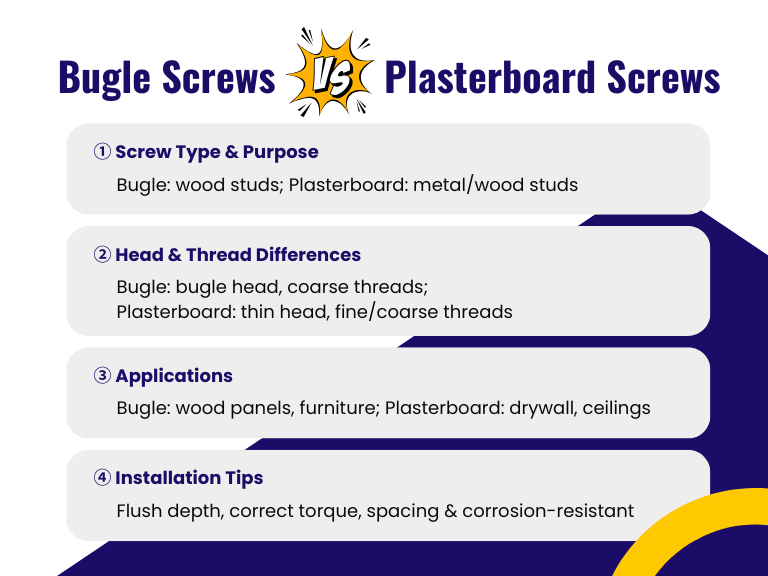
When working on renovations, woodworking, or plasterboard installations, choosing the right screws is essential. Screws provide structural support and affect the finish and durability of your project. While bugle screws and plasterboard screws may look similar, they differ in application, material, thread design, and holding strength. Using the wrong type can cause board cracks, loose fittings, or rework. This article explains their differences, best uses, and expert installation tips to help you make the right choice.
What Are Bugle Screws?
Bugle screws are commonly used in woodworking and drywall construction. Their most distinctive feature is the bugle-shaped head, which distributes pressure evenly to prevent surface cracking. Key features include:
- Head Design: The bugle head allows the screw to sit flush with plasterboard or wood, ensuring a smooth surface for finishing, jointing, and painting.
- Tip and Thread: Sharp tips and deep threads allow screws to bite into wood quickly, increasing installation efficiency.
- Material & Rust Protection: Black phosphate or zinc-plated steel provides corrosion resistance, suitable for indoor applications.
- Compatible Materials: Wood studs, plasterboard, plywood, and OSB panels.
- Installation Convenience: Usually no pilot hole is needed, saving time on construction.
Common Applications:
- Wood stud partitions
- Residential renovations and furniture assembly
- Light interior partitions and wooden support structures
- DIY woodworking projects
Bugle screws work best with wood, but they may slip or fail when used with metal studs.
What Are Plasterboard Screws?
Plasterboard screws are specifically designed for securing plasterboard and vary depending on the type of framing:
-
Fine Thread Screws: Designed for metal studs. Sharp threads provide high holding power in thin steel without stripping.
-
Coarse Thread Screws: Suitable for wood studs. Coarse threads quickly bite into wood fibers for strong and stable fixing.
Additional features:
-
Head Design: Often bugle heads, reducing the risk of cracking and maintaining a smooth board surface.
-
Material Hardness: Made of hardened steel to withstand long-term use and prevent breakage.
-
Versatile Applications: Ideal for walls, ceilings, and light partition projects.
Plasterboard screws provide superior protection for plasterboard, especially in metal stud installations, preventing slipping and board damage.
Structural Differences Between Bugle and Plasterboard Screws
Choosing the right screw depends on the substrate and project requirements:
Head:
-
Bugle screws: Slightly thicker head, optimized for wood.
-
Plasterboard screws: Thinner, distributes pressure more precisely to avoid cracking.
Thread:
-
Bugle screws: Coarse threads for wood fastening.
-
Plasterboard screws: Fine or coarse threads depending on the stud material, optimized for plasterboard.
Material Hardness:
-
Plasterboard screws: Hardened steel with high tensile and shear strength, suitable for metal studs.
-
Bugle screws: More flexible, ideal for wood fastening.
Holding Characteristics:
-
Plasterboard screws: Excellent tensile strength for wall and ceiling applications.
-
Bugle screws: Strong shear strength, ideal for wood structural support.
Understanding these differences helps prevent slipping, cracking, or inadequate fixing during installation.
Applications and Best Use Cases
Choosing the right screw depends on the substrate and project requirements:
Bugle Screws Applications
- Wood stud framing
- Securing plasterboard to wood
- Plywood, OSB, and other wood panels
- Woodwork and furniture assembly
- DIY woodworking projects
Plasterboard Screws Applications
- Securing plasterboard
- Metal studs (fine thread) or wood studs (coarse thread)
- Ceilings and partition walls
- Professional plasterboard projects
Common Mistakes
- Using bugle screws on plasterboard attached to metal studs → may slip.
- Using plasterboard screws on thick wood → may break.
- Using regular screws as a substitute → board cracking, weak fixing.
Selecting the correct screws saves time, effort, and prevents costly rework.
Bugle Screws and Plasterboard Screws: Expert Installation Tips
Even with the right screw, proper installation ensures board stability and surface integrity:
-
Control Screw Depth: Screw heads should sit flush or slightly recessed. Too deep can damage board paper; too shallow affects aesthetics. Use a torque-controlled screwdriver for precision.
-
Screw Gun Speed and Torque: Medium speed is optimal for plasterboard. Too fast may slip; too slow may shift the screw or crack the board. Test speed and torque in a non-visible area first.
-
Edge Distance: Keep screws at least 10–15 mm from board edges to avoid cracking.
-
Thread Selection: Fine-thread plasterboard screws for metal studs, bugle screws or coarse-thread plasterboard screws for wood studs.
-
Screw Spacing: 200–300 mm is typical; ceilings or large panels may require closer spacing for stability.
-
Pilot Holes for Hard Wood: Recommended to prevent splitting, screw breakage, or misalignment. Hole diameter slightly smaller than screw body.
-
Rust-Resistant Material: Black phosphate or zinc-plated screws increase longevity and keep surfaces clean, especially in humid environments.
Following these tips maximizes the performance of bugle screws and plasterboard screws, minimizes damage and rework, and ensures long-term stability.
Frequently Asked Questions (FAQ)
Q:Can bugle screws be used in plasterboard?
A: Yes, only for plasterboard attached to wood studs. For metal studs, fine-thread plasterboard screws are recommended.
Q:Are plasterboard screws suitable for wood?
A:Coarse-thread plasterboard screws can be used for wood, but bugle screws are better for wood stud applications.
Q:What is the difference between bugle screws and regular screws?
A:Bugle screws have a bugle-shaped head to reduce board cracking; regular screws lack this design.
Q:Do I need to pre-drill holes for bugle screws or plasterboard screws?
A:Generally not, but for hardwood or dense boards, pre-drilling prevents splitting or screw breakage.
Q:How do I choose the right length and type of screw for my project?
A:Select based on board thickness and substrate. Use plasterboard screws for plasterboard, bugle screws for wood.
Further reading:
Cyclone Rated Roofing Screws — What Makes Them Wind Resistant?
Colorbond Roofing Screws — Prevent Rust and Maintain Roof Aesthetics
Polycarbonate Roof Screws — How to Fix Sheets Without Cracking
Metal Roof Screws — Choosing the Right Seal and Washer Type
Roofing Fasteners 101 — Preventing Leaks and Corrosion