
Latest News
- Home
- Latest News
- Plasterboard Screws: Coarse vs Fine? 3 Mins to Decide
2026.09.02
Latest News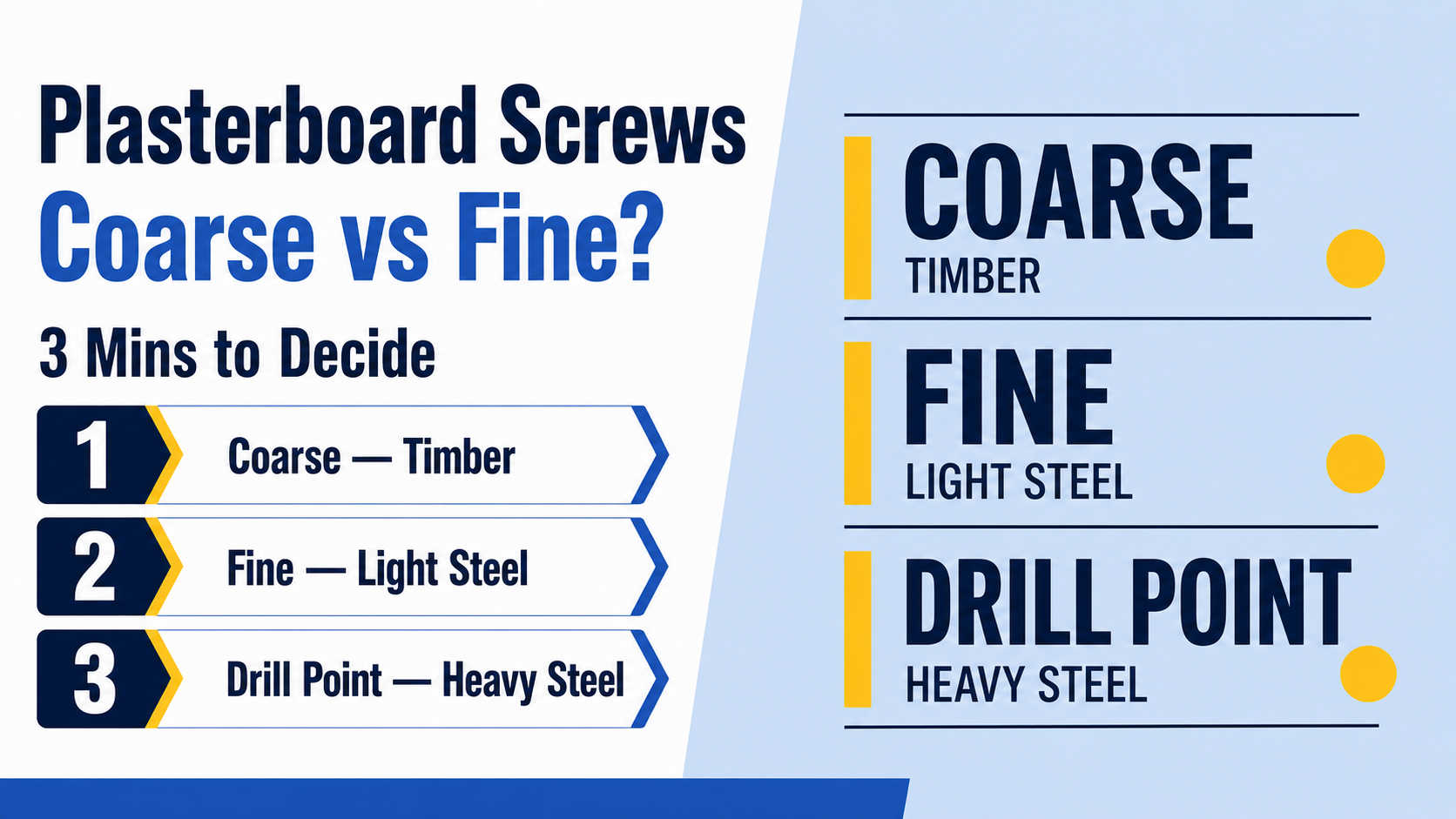
Choosing between Self Tapping Screws and Plasterboard Screws can be confusing because both products may have sharp points, threaded shanks, and similar dark finishes. However, they are designed for different fastening situations.
Self Tapping Screws are a broad group of fasteners that create or form threads as they enter a material. Plasterboard Screws are specialized fasteners designed to secure plasterboard or drywall panels to timber or metal framing.
For a quick decision:
- Choose coarse-thread Plasterboard Screws for timber studs.
- Choose fine-thread Plasterboard Screws for light-gauge steel studs.
- Choose suitable drill-point screws when fixing plasterboard to thicker steel.
- Choose general Self Tapping Screws according to the substrate, point, head, diameter, and required thread engagement.
What Are Self Tapping Screws?
What Are Self Tapping Screws?
Self Tapping Screws are fasteners that create mating threads as they are driven into a prepared hole or suitable material. Depending on the design, they may form threads by displacing the surrounding material or cut threads by removing a small amount of material.
The term describes how the screw creates its thread engagement. It does not indicate one specific head, point, drive, material, or surface treatment.
Self Tapping Screws may be manufactured with:
- Sharp, blunt, or drill-style points
- Thread-forming or thread-cutting designs
- Pan, hex, countersunk, wafer, or bugle heads
- Phillips, square, hex, or star drives
- Carbon steel, stainless steel, or other materials
- Zinc-plated, galvanized, phosphate, or specialized coatings
A self-tapping screw is not necessarily a self-drilling screw. Self-tapping products form their mating threads, but some still require a pilot hole. Self-drilling screws include a drill-shaped point that can produce the hole before the threads engage.
How Do Self Tapping Screws Work?
Self Tapping Screws work by engaging the substrate and forming or cutting a matching internal thread. Once the thread is established, it resists pull-out and holds the connected materials together.
The installation process generally involves three stages:
Starting the screw: The point locates the fastening position and begins penetrating the material.
Creating the thread: The screw forms or cuts mating threads into the substrate.
Clamping the materials: The head applies pressure and holds the connected components together.
Thread-forming screws push the material aside to produce a mating thread. This can create strong engagement because the substrate is displaced rather than removed. However, the material must be sufficiently ductile to avoid cracking.
Thread-cutting screws have cutting features that remove material as the screw advances. They can be useful in comparatively hard materials or applications where lower driving torque is required.
Self-drilling screws combine drilling and tapping functions. Their drill point creates the hole, after which the threads engage the substrate. The drill-point capacity must be suitable for the total thickness of the material being drilled.
Where Are Self Tapping Screws Used?
Self Tapping Screws are widely used in construction, manufacturing, automotive work, ventilation systems, appliances, electrical enclosures, and general assembly.
Common applications include:
- Joining sheet-metal components
- Fixing metal panels to light-gauge framing
- Installing ventilation ducts
- Attaching brackets and accessories
- Assembling electrical enclosures
- Securing plastic components
- Installing metal roofing and cladding
- Connecting light structural components
- Fastening gypsum panels to suitable metal framing
The correct screw depends on the substrate. A product intended for thin sheet metal may not have enough drilling capacity for a thick steel support. A screw designed for plastic may also have a different thread form from one intended for steel.
How to Choose Self Tapping Screws
How to Choose Self Tapping Screws?
Start by identifying the materials being joined and the thickness of the supporting material. Then compare the screw’s point, thread, head, diameter, length, drive, material, and coating.
Use the following checklist:
- Identify the substrate: Is it thin steel, thick steel, aluminium, timber, plastic, or a combination of materials?
- Measure the material thickness: Confirm the thickness of every layer the screw must penetrate.
- Select the point: Decide whether a pilot hole, sharp point, thread-cutting point, or self-drilling point is required.
- Check the thread: Match the thread pitch and geometry to the substrate.
- Choose the head: Consider surface finish, clamping area, tool access, and required clearance.
- Confirm the length: The screw must pass through the attached material and provide sufficient engagement in the supporting material.
- Check corrosion resistance: Match the screw material and coating to indoor, humid, exterior, industrial, or marine conditions.
- Verify installation torque: Excessive torque may strip thin material, damage the head, or deform the connected component.
Buyers should also confirm whether the screw is intended for load-bearing connections. General-purpose Self Tapping Screws should not be substituted for specified structural fasteners without engineering approval.
What Point Type Is Suitable?
Point design affects how easily the screw penetrates the material and whether a pilot hole is required.
| Point type | Suitable application | Main consideration |
|---|---|---|
| Sharp point | Thin metal, plastic, plasterboard systems, and selected light materials | Material must be thin or soft enough for penetration |
| Thread-forming point | Ductile metals and plastics | Forms threads by displacing material |
| Thread-cutting point | Harder materials or prepared pilot holes | Cuts material to create mating threads |
| Self-drilling point | Sheet metal and steel supports | Drilling capacity must match the steel thickness |
| Type 17-style point | Timber and wood-based materials | Cutting feature helps the screw start in wood |
Do not choose a self-drilling point simply because it appears stronger. In very thin metal framing, an unsuitable drill point may remove too much material before the threads engage, reducing holding performance.
For plasterboard fixed to thin steel studs, sharp-point fine-thread screws are commonly used. For heavier steel framing, a suitable drill-point screw may be necessary.
What Head Type Should Buyers Pick?
Head selection depends on the desired surface finish and the function of the connection.
- Bugle head: Commonly used for plasterboard because its curved shape creates a controlled recess without concentrating excessive pressure on the paper surface.
- Pan head: Provides a relatively broad bearing surface and remains visible above the material.
- Wafer head: Offers a low profile and a wider clamping area.
- Hex head: Allows higher installation torque and is common in metal construction and roofing.
- Countersunk head: Sits flush in a prepared countersink but may damage plasterboard if it is not designed for the material.
- Truss head: Provides a wide bearing surface for thin materials.
For plasterboard, a purpose-designed bugle head is generally preferable to a conventional countersunk or pan head. The screw should sit slightly below the board surface without breaking the face paper or crushing the gypsum core.
What Are Plasterboard Screws?
What Are Plasterboard Screws?
Plasterboard Screws are specialized fasteners used to attach plasterboard or drywall panels to timber framing, steel studs, or—in selected systems—other plasterboard panels.
A typical plasterboard screw has:
- A bugle-shaped head
- A slim hardened-steel shank
- A sharp or self-drilling point
- Coarse or fine threads
- A power-tool-compatible drive
- A finish suitable for its intended environment
The bugle head is an important feature. Its curved underside allows the screw to form a shallow recess while spreading pressure more gradually across the board surface. This recess can later be covered with joint compound.
Industry guidance states that screws should be driven slightly below the plasterboard surface without breaking the face paper, damaging the core, or stripping the framing material. Screws for standard steel or timber framing and those for heavier steel framing may also be covered by different product specifications.
Where Are Plasterboard Screws Used?
Plasterboard Screws are primarily used in interior wall and ceiling systems, including:
- Residential partition walls
- Suspended or framed ceilings
- Office and retail interiors
- Hotel and apartment construction
- Timber-framed walls
- Light-gauge steel framing
- Multiple-layer plasterboard assemblies
- Fire-rated and acoustic systems
- Renovation and repair work
Different screws may be required for different layers or systems. A single-layer wall, multilayer fire-rated assembly, ceiling installation, and impact-resistant panel system may each have specific fastener requirements.
The board manufacturer’s installation instructions and applicable building requirements should be checked before selecting screw spacing, penetration, and length. Standards for gypsum board installation also cover factors such as framing, fastener spacing, substrates, and finishing requirements.
Why Choose Plasterboard Screws?
Ordinary general-purpose screws may have the wrong head shape, thread geometry, or shank design for plasterboard. They may tear the paper surface, crush the gypsum core, protrude above the surface, or provide poor engagement with the framing material.
Purpose-designed Plasterboard Screws offer several advantages:
✦ Controlled countersinking: The bugle head forms a recess suitable for joint compound.
✦ Reduced paper damage: The curved head profile spreads pressure around the fastening point.
✦ Fast installation: Sharp points and suitable drives support efficient screw-gun installation.
✦ Substrate-specific threads: Coarse and fine threads are available for timber and steel.
✦ Consistent finishing: Correct installation creates a smooth surface for later finishing.
✦ Reliable engagement: The thread is designed for the intended supporting material.
Plasterboard Screws are generally intended for protected interior applications unless their material, coating, and product specifications state otherwise. A standard phosphate-coated plasterboard screw should not automatically be used for outdoor, wet, or highly corrosive environments.
How to Choose Plasterboard Screws
How to Choose Plasterboard Screws?
The first step is to identify the framing material. This determines whether coarse, fine, or drill-point threads are appropriate.
A simple selection table is provided below:
| Application | Typical screw selection | Reason |
|---|---|---|
| Plasterboard to timber studs | Coarse-thread plasterboard screw | Wider threads grip timber effectively |
| Plasterboard to light-gauge steel studs | Fine-thread plasterboard screw | Closely spaced threads engage thin steel |
| Plasterboard to heavier steel framing | Suitable drill-point plasterboard screw | Drill point penetrates thicker steel before thread engagement |
| Plasterboard to plasterboard | Laminating screw specified for the system | Designed to connect gypsum panels without conventional framing |
| Multiple layers of plasterboard | Longer screw with the correct thread | Must pass through all layers and engage the support |
| Fire-rated or acoustic assembly | Screw specified by the tested system | Substitution may affect rated performance |
After selecting the thread, check:
- Board type and thickness
- Number of plasterboard layers
- Timber or steel framing
- Steel thickness
- Required penetration
- Screw diameter and length
- Head and drive design
- Indoor environmental conditions
- Installation tool and speed
- Applicable building or tested-system requirements
Coarse Thread or Fine Thread?
The easiest way to choose between coarse and fine threads is to look behind the plasterboard.
Choose coarse-thread screws for timber
Coarse-thread Plasterboard Screws have wider spacing between the threads. The deeper, more widely spaced thread profile can bite effectively into timber and move through the material quickly.
They are commonly selected for:
- Timber wall studs
- Timber ceiling battens
- Wood framing
- Selected wood-based supports
Coarse threads are generally not recommended for thin steel framing because the wide spacing may provide too few points of engagement in the metal.
Choose fine-thread screws for light-gauge steel
Fine-thread Plasterboard Screws have more threads along the same shank length. This allows multiple threads to engage with thin metal framing.
They are commonly selected for:
- Light-gauge steel studs
- Metal ceiling framing
- Interior steel partition systems
- Thin steel furring channels
Fine-thread sharp-point screws are typically suitable only within their specified metal-thickness range. If the steel is too thick, the screw may fail to penetrate correctly.
Choose a drill point for heavier steel
For comparatively thick steel framing, use a plasterboard screw with a drilling point and capacity appropriate for the metal thickness.
The product data should state the supported steel-thickness range. Do not estimate drilling capacity based solely on the screw’s appearance.
What Length Should Buyers Pick?
The correct length depends on:
- Plasterboard thickness
- Number of board layers
- Framing material
- Required embedment
- Head position
- Installation system
- Fire or acoustic rating
The screw must be long enough to pass through the plasterboard and achieve the required engagement in the timber or steel support. A screw that is too short may not provide adequate holding performance. A screw that is unnecessarily long may be slower to install and could contact concealed wiring, pipes, or other services.
Common plasterboard thicknesses include approximately 9.5, 12.5, and 15 mm, although dimensions vary by market and board type. Frequently used screw lengths include approximately 25, 32, 38, 41, 50, and 65 mm.
These are product categories rather than universal installation recommendations. The final length should follow the plasterboard supplier’s instructions and the requirements of the wall or ceiling system.
A practical selection process is:
- Add together the thickness of every plasterboard layer.
- Determine the required penetration into the framing.
- Select the shortest screw that provides the specified engagement.
- Check for electrical cables, pipes, and other concealed services.
- Confirm the length against the assembly documentation.