
Latest News
- Home
- Latest News
- How to Choose COLORBOND® Roofing Screws? 3 Steps to Improve Rust Protection
2026.09.02
Latest News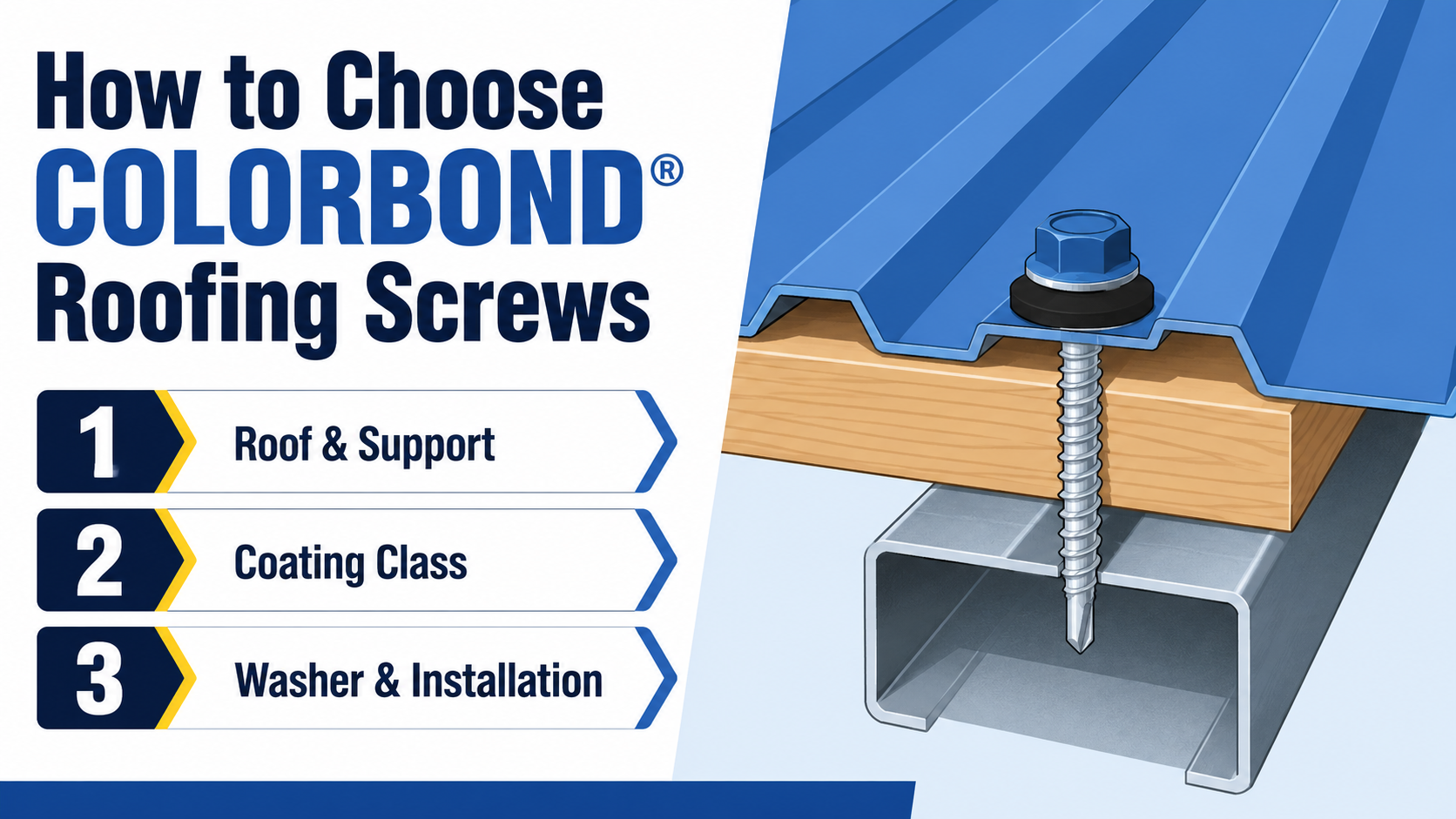
Choosing the right roofing screw involves more than finding the correct length or matching the screw-head colour. Buyers must consider the roofing profile, supporting material, corrosion-resistant coating, sealing washer and surrounding environment.
This is especially important when selecting COLORBOND® Roofing Screws. Two screws may look almost identical but have different drill points, coating classes or substrate limitations. Choosing an unsuitable fastener can result in installation failure, water leakage or premature corrosion.
This article explains how to compare COLORBOND® Roofing Screws in three practical steps:
- Match the screw to the roof sheet and supporting material.
- Select an appropriate corrosion-protection class.
- Check the washer, screw length and installation requirements.
What Are COLORBOND® Roofing Screws?
COLORBOND® Roofing Screws generally refers to fasteners selected for installing roofing or cladding manufactured from COLORBOND® pre-painted steel.
These fasteners commonly feature a corrosion-resistant coating, hexagonal head and sealing washer. Painted heads are also available to coordinate with popular COLORBOND® steel colours.
However, colour matching alone does not confirm whether a screw is suitable. Buyers must still check its complete specification, including:
- Screw gauge and length
- Timber or steel substrate compatibility
- Type 17 or self-drilling point
- Drilling capacity
- Corrosion-protection class
- Washer material and diameter
- Roofing profile compatibility
- Environmental exposure limitations
- Manufacturer warranty conditions
A colour-matched screw with insufficient corrosion resistance may deteriorate before the surrounding roof sheet. For this reason, the fastener coating and application rating should be considered before selecting the head colour.
Where Are COLORBOND® Roofing Screws Used?
COLORBOND® Roofing Screws may be used to secure compatible metal roofing or wall cladding to timber battens, steel purlins, top hats and other supporting structures.
Common applications include:
- Corrugated steel roofing
- Ribbed and trapezoidal roof profiles
- COLORBOND® steel roofing and walling
- Residential sheds and garages
- Carports, patios and pergolas
- Agricultural and industrial buildings
- Metal fencing and exterior cladding
- Flashings, ridge capping and side laps
- Roof-sheet repairs and replacement work
The correct screw depends on both the roofing profile and the material underneath the sheet.
A Type 17 roofing screw is commonly used when fixing metal roofing into timber. Its pointed tip helps the screw start and cut into the timber substrate.
When the support is steel, a compatible self-drilling roofing screw is usually required. Its drill point must be capable of penetrating the actual thickness and grade of the steel support.
Roof profile is another important consideration. Some profiles are fixed through the crest, while others use concealed clips or different fixing positions. Always follow the roofing manufacturer’s installation instructions rather than choosing fasteners by appearance alone.
Why Use Purpose-Selected COLORBOND® Roofing Screws?
Purpose-selected COLORBOND® Roofing Screws help create a compatible and weather-resistant fastening system. They secure the roof sheet while reducing the risk of moisture entering through the fixing hole.
Their main benefits include:
✦ Material compatibility: Appropriate fasteners help reduce premature corrosion and adverse reactions between different metals.
✦ Weather sealing: A correctly installed sealing washer helps prevent water from entering around the fixing hole.
✦ Colour coordination: Painted screw heads can complement COLORBOND® steel roofing and cladding.
✦ Efficient installation: Hexagonal heads can be installed using suitable roofing drivers.
✦ Substrate options: Different screws are available for timber battens and steel supports.
✦ Environmental protection: Different coating classes allow the fastener to be matched to the project’s exposure conditions.
The fastener should provide durability appropriate for the expected service life of the roofing system. Using a low-grade screw with a durable roof sheet may cause the fastener to fail first.
Are All COLORBOND® Roofing Screws the Same?
No. COLORBOND® Roofing Screws may have similar shapes and colours but differ substantially in performance and intended use.
A typical roofing screw may include:
- A hex flange head
- A hardened carbon-steel body
- A Type 17 or self-drilling point
- A corrosion-resistant coating
- An EPDM sealing washer
- A painted or powder-coated head
Two screws with the same gauge, length and colour may have different coating classes. Their drill points may also be designed for different supporting materials.
One screw may be suitable for timber, while another may be designed for light-gauge steel. A separate product may be required for thicker steel purlins.
Therefore, paint colour should be the final matching step—not the first selection criterion.
How Do You Choose Rust-Resistant COLORBOND® Roofing Screws?
A practical selection process involves checking the supporting material, corrosion class and sealing components.
Step 1: Match the Screw to the Roof and Support
Before choosing COLORBOND® Roofing Screws, identify the roofing sheet and its supporting structure.
Check the following:
- What roofing profile is being installed?
- Is the roof fixed to timber battens or steel purlins?
- What is the thickness of the roofing sheet?
- What is the thickness and grade of the supporting steel?
- Is the roof crest-fixed, pan-fixed or clip-fixed?
- What penetration depth is required?
- What wind-load requirements apply?
- What fixing pattern does the roof-sheet manufacturer specify?
For timber supports, choose a roofing screw designed specifically for timber, commonly featuring a Type 17 point.
For metal supports, select a self-drilling screw with a drilling capacity that covers the actual steel thickness. Do not use a screw intended for thin steel on a substantially thicker steel purlin. The drill point may overheat, become damaged or fail to penetrate the support correctly.
For concealed-fix roofing systems, visible roofing screws may not be used to secure the main sheet. These systems generally require manufacturer-specified clips and compatible fasteners.
Step 2: Choose the Appropriate Coating Class
Roofing screws are continuously exposed to moisture, condensation, pollutants, salt and temperature changes. The fastener’s corrosion resistance must therefore suit the roofing material and local environment.
The appropriate coating depends on factors such as:
- Distance from the coast or breaking surf
- Exposure to airborne salt
- Industrial pollution
- Persistent moisture or condensation
- Chemical fumes
- Sheltered areas that are not regularly washed by rain
- Roof accessibility and expected service life
- Roofing manufacturer requirements
A simplified comparison is shown below:
| Coating option | General application | Important consideration |
|---|---|---|
| Class 3 | Many general exterior roofing and cladding applications | Must still match the roofing product and local exposure conditions |
| Class 4 | More demanding exterior or marine-influenced environments | Often considered where greater corrosion resistance is required |
| Proprietary high-performance coating | Selected severe or highly corrosive applications | Confirm its tested performance, warranty and roofing compatibility |
| Stainless steel | Specialist roofing systems and selected severe environments | Stainless grade and compatibility with the roof sheet must be verified |
LYSAGHT® currently advises using fasteners complying with AS 3566 Class 3 or better for COLORBOND® steel applications. Its location-specific guidance lists Class 3 for many external applications more than 400 metres from the ocean or another severe influence, and Class 4 for certain severe marine exposures approximately 200 to 400 metres away. Local conditions and the selected roofing product may change these requirements.
Coating class should not be selected by price alone. Consider the expected roof life, accessibility and future cost of replacing corroded fasteners.
Step 3: Check the Washer and Installation Details
Where a screw penetrates a metal roof sheet, an appropriate sealing washer is generally required. EPDM sealing washers are commonly used to create a weather-resistant seal around the fixing hole.
The washer must sit evenly against the roof sheet. Installation pressure is important:
- An underdriven screw may leave a gap that allows water to enter.
- An overdriven screw may crush, split or deform the washer.
- A tilted screw may create an uneven seal.
- Excessive torque may strip the supporting material.
- Incorrect driver speed may overheat or damage the drill point.
- Metal swarf left on the roof may stain or damage the sheet.
Use a depth-controlled screw gun or an appropriate torque setting. The washer should be compressed sufficiently to form a seal without being forced outward or damaged.
Is Class 3 Enough for COLORBOND® Roofing Screws?
Class 3 fasteners may be suitable for many general exterior roofing and wall-cladding applications. However, Class 3 should be treated as a starting point rather than a universal answer.
A higher corrosion-resistance level may be necessary when the building is exposed to:
- Breaking surf or airborne sea salt
- Severe coastal conditions
- Industrial pollution
- Persistent moisture
- Chemical fumes
- Unwashed or sheltered exterior areas
- Severe local microclimates
- Roofing products designed for more demanding environments
The roofing manufacturer, fastener supplier, building designer or engineer should confirm the final selection when exposure conditions are uncertain.
When Should Buyers Choose Class 4 Fasteners?
Class 4 fasteners should be considered when the roof is exposed to more demanding environmental conditions or when the roofing system specifically requires enhanced corrosion resistance.
They may be appropriate when:
- The property is near the coast
- The roof receives airborne salt or occasional salt spray
- The building is located in a severe industrial environment
- The roofing material is intended for severe exposure
- Replacing corroded fasteners would be difficult or costly
- Project documentation specifies Class 4 fasteners
- The roofing manufacturer recommends additional protection
Distance from the coast should not be the only deciding factor. Wind direction, building height, topography, nearby surf conditions and areas sheltered from rain can all influence corrosion risk.
What Size COLORBOND® Roofing Screws Should You Choose?
There is no single screw size suitable for every COLORBOND® steel roof.
Common roofing fasteners include 12G and 14G screws in lengths such as 35, 45, 50 and 65 mm. However, the correct specification depends on:
- Roofing profile
- Crest or pan height
- Fixing position
- Roofing-sheet thickness
- Supporting material
- Required penetration
- Insulation or spacer thickness
- Wind-load requirements
When reading a screw specification such as 12-14 × 50:
- 12 indicates the screw gauge.
- 14 indicates the number of threads per inch.
- 50 indicates the nominal screw length in millimetres.
Always use the size specified by the roof-profile supplier, building designer or project documentation.
COLORBOND® Roofing Screw Selection Checklist
Before ordering COLORBOND® Roofing Screws, confirm the following information:
- Roof-sheet brand and profile
- Roof-sheet thickness
- Timber or steel support
- Supporting steel thickness
- Required screw gauge
- Required screw length
- Type 17 or self-drilling point
- Drill-point capacity
- Corrosion-protection class
- EPDM sealing washer
- Washer diameter
- Head colour
- Coastal or industrial exposure
- Relevant installation instructions
- Product warranty and limitations
Providing these details to the screw manufacturer or supplier can reduce selection errors and help ensure the fastener is suitable for the roofing system.
Frequently Asked Questions
Q:What are COLORBOND® Roofing Screws? +
Q:Are all colour-matched roofing screws suitable for COLORBOND® steel? +
Q:What size screws are used for COLORBOND® steel roofs? +
Q:Are timber and steel roofing screws different? +
Q:Do COLORBOND® Roofing Screws need washers? +
Q:Is Class 3 suitable for exterior roofing? +
Q:Should coastal roofs use Class 4 screws? +
Q:Can stainless-steel screws be used with COLORBOND® steel? +
Q:Why do roofing screws rust before the roof sheet? +
Q:Can old roofing screws be reused? +
Choose COLORBOND® Roofing Screws by Specification, Not Colour Alone
The right COLORBOND® Roofing Screws must match the roofing profile, supporting material and environmental exposure. Start by identifying whether the roof is fixed to timber or steel, then compare the corrosion class, drill-point capacity, screw length and sealing washer.
A colour-matched head provides a cleaner appearance, but it should only be selected after the technical requirements have been confirmed.
Need help selecting suitable COLORBOND® Roofing Screws for timber battens, steel purlins or coastal roofing applications? Contact us with your roof profile, support material and project location for product recommendations.