
Latest News
- Home
- Latest News
- How to Choose Right Plasterboard or Bugle Screws?
2026.09.02
Latest News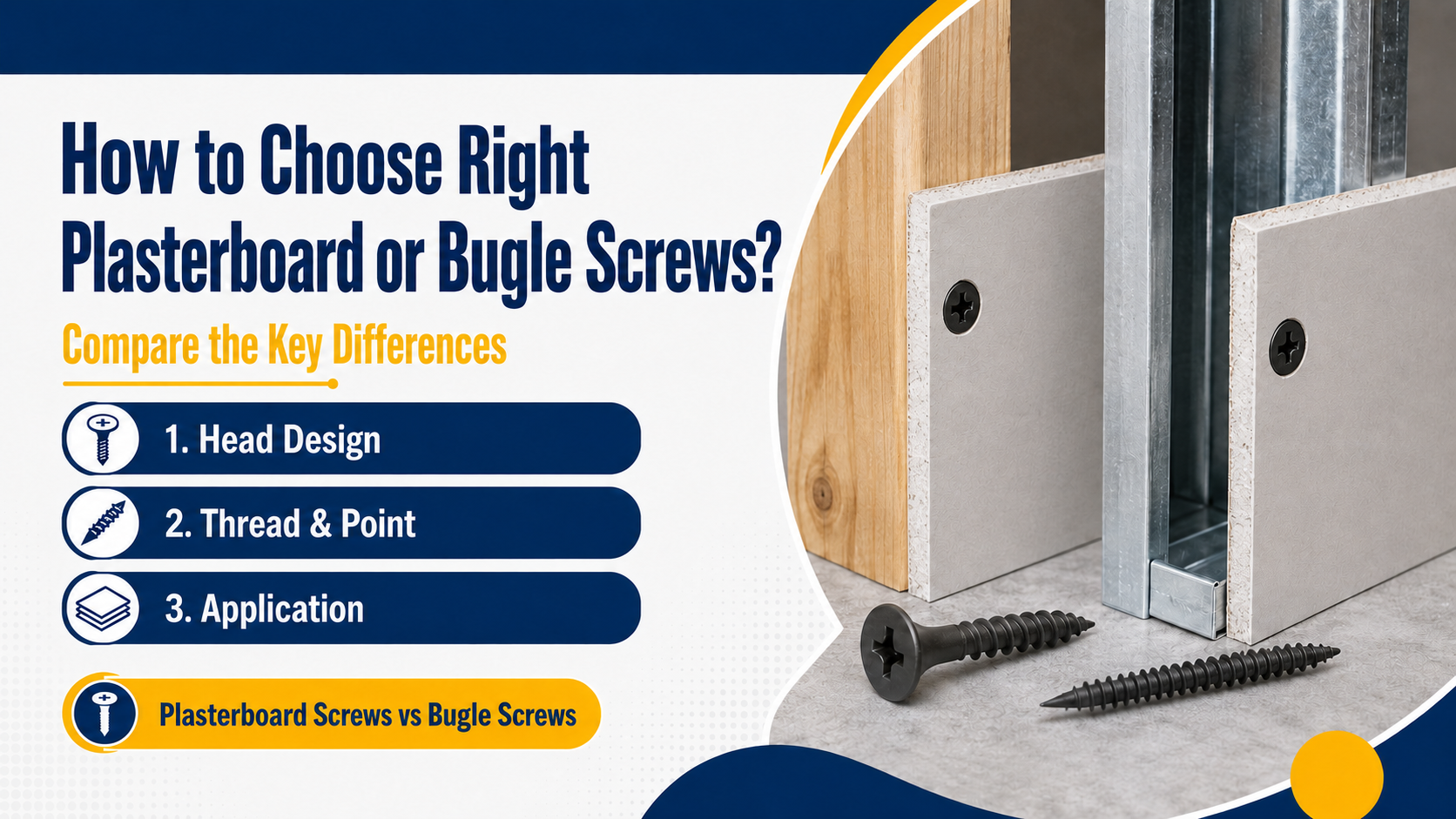
Choosing the correct screws is essential when installing plasterboard, drywall panels, timber framing, or light-gauge metal components. Although Plasterboard Screws and Bugle Screws are often mentioned together, these terms do not always describe exactly the same product. Plasterboard screws are defined mainly by their intended application, while bugle screws are identified by their distinctive head shape.
Understanding the differences in head design, thread type, point style, length, material, and surface treatment can help buyers select suitable fasteners for each project. This guide explains how plasterboard screws and bugle screws work, where they are used, and what buyers should check before ordering.
What Are Plasterboard Screws?
Plasterboard Screws are specialized fasteners designed primarily for securing plasterboard or drywall sheets to timber or metal framing. They usually feature a sharp point, a slim shank, and a bugle-shaped head that allows the screw to sit neatly below the board surface without causing excessive damage to the paper facing.
Most plasterboard screws are manufactured from hardened carbon steel and are commonly supplied with black phosphate, zinc-plated, or other protective surface treatments. Depending on the substrate, they may have coarse threads, fine threads, or self-drilling points.
The correct screw specification depends on several factors, including:
- The thickness of the plasterboard
- Whether the frame is timber or metal
- The thickness of the metal stud
- The required embedment depth
- Indoor or moisture-prone conditions
- Installation speed and tool compatibility
Where Are Plasterboard Screws Used?
Plasterboard screws are most commonly used in interior wall and ceiling systems. Their primary purpose is to fasten plasterboard panels securely while creating a surface that can be covered with joint compound and finished smoothly.
Typical applications include:
- Attaching plasterboard to timber studs
- Fastening drywall to light-gauge metal framing
- Installing interior partition walls
- Fixing ceiling boards to framing systems
- Renovating residential and commercial interiors
- Constructing offices, retail spaces, hotels, and apartments
- Installing multiple layers of fire-rated or acoustic plasterboard
For timber framing, coarse-thread plasterboard screws are generally preferred because the wider thread spacing grips wood effectively. For light-gauge steel studs, fine-thread screws are commonly used because the closer threads engage thin metal more securely.
If the metal framing is thicker, a self-drilling plasterboard screw may be required. Its drill-point design can penetrate the metal without a separate pilot hole, although the suitable drilling capacity should always be confirmed before use.
Why Choose Plasterboard Screws?
Plasterboard is relatively soft and has a paper-faced surface, so ordinary screws may not provide the correct holding performance or finish. A screw with an unsuitable head could tear the paper, crush the plaster core, or remain above the surface.
Plasterboard screws offer several practical advantages:
✦ Controlled installation: The head is designed to sit slightly below the surface without cutting completely through the paper.
✦ Fast penetration: A sharp point helps the screw start quickly in plasterboard and framing materials.
✦ Suitable thread options: Coarse, fine, and self-drilling versions are available for different substrates.
✦ Clean finishing: The recessed screw head can be covered with joint compound.
✦ Efficient installation: They are compatible with screw guns, depth setters, and automatic feeding systems.
✦ Consistent fastening: Purpose-designed screws help installers maintain uniform spacing and embedment.
However, plasterboard screws are not automatically suitable for every structural, exterior, or high-moisture application. Their material, coating, corrosion resistance, and load capacity must match the actual installation environment.
What Are Bugle Screws?
Bugle Screws are screws with a curved transition between the shank and the head. Instead of having a flat underside like many conventional countersunk screws, a bugle-head screw has a smooth, tapered profile that resembles the bell of a bugle.
This head shape distributes pressure more gradually as the screw enters the material. It can create a neat recess while reducing the risk of tearing or crushing softer surfaces. For this reason, bugle heads are widely used in plasterboard, drywall, timber boards, decking, and other applications where surface protection is important.
The term “bugle screw” primarily describes the screw’s head design. It does not automatically define the thread, material, point, coating, or intended substrate.
A bugle screw may be supplied with:
- Coarse or fine threads
- Sharp or self-drilling points
- Phillips, square, or star drives
- Carbon steel or stainless steel
- Phosphate, zinc, mechanical plating, or specialized coatings
- Different lengths and diameters
Why Use Bugle Screws?
The main advantage of bugle screws is their ability to produce a clean, controlled finish in comparatively soft materials. Their curved head profile helps reduce concentrated pressure around the screw hole.
Key benefits include:
- Reduced surface damage: The curved head transition helps limit tearing around the fastening point.
- Neat countersinking: The head can sit flush with or slightly below the surface.
- Improved load distribution: Pressure is spread more gradually than with some conventional head designs.
- Efficient driving: Bugle screws are suitable for power-tool installation.
- Wide specification range: Buyers can select different threads, points, drives, materials, and coatings.
- Versatile applications: Depending on their design, they may be used with plasterboard, wood panels, light-gauge metal, or decking materials.
The head shape alone does not guarantee suitable performance. A bugle screw must still have the correct thread, point, diameter, length, material, and corrosion protection for the intended project.
Are Bugle Screws for Plasterboard?
Yes, many bugle screws are designed for plasterboard installation. In fact, the familiar plasterboard screw typically uses a bugle head because this shape helps the screw form a shallow recess without seriously damaging the plasterboard’s paper surface.
However, not every bugle screw is a plasterboard screw.
Some bugle screws are designed specifically for timber, decking, or general construction. These products may have different shank diameters, thread geometries, coatings, drive systems, or mechanical properties. A screw intended for exterior timber construction may have a bugle head but may not be optimized for fixing plasterboard to light-gauge metal studs.
Buyers should therefore check the complete product specification instead of choosing a screw based only on its head shape.
Where Are Bugle Screws Applied?
The application of a bugle screw depends on its complete design. Common uses include:
- Plasterboard and drywall installation
- Timber framing and wood-panel fastening
- Interior partitions and ceiling systems
- Decking and outdoor timber projects
- Furniture and cabinet assembly
- Light construction work
- Composite board installation
- Renovation and repair projects
For plasterboard work, the screw should be explicitly designed for plasterboard or drywall installation. For outdoor timber applications, corrosion resistance becomes especially important. Stainless steel or screws with an appropriate exterior-grade coating may be required, depending on the environment and the materials being fastened.
What Is the Difference Between Plasterboard Screws and Bugle Screws?
The main difference is what each term describes. Plasterboard Screws are categorized according to their primary application, while Bugle Screws are categorized according to their head shape.
A plasterboard screw normally has a bugle head, but a bugle-head screw may be designed for plasterboard, timber, decking, or another material. Therefore, the two product categories overlap, but they are not completely interchangeable.
Plasterboard Screws vs Bugle Screws
| Feature | Plasterboard Screws | Bugle Screws |
|---|---|---|
| Primary definition | Defined by their use with plasterboard or drywall | Defined by their curved bugle-head profile |
| Common applications | Fixing plasterboard to timber or metal frames | Plasterboard, timber, decking, boards, and general construction |
| Head design | Usually a bugle head | Always features a bugle-shaped head |
| Thread options | Coarse, fine, or self-drilling | Varies according to the intended application |
| Point style | Sharp point or drill point | Sharp, drill, or other point styles |
| Typical finish | Black phosphate, zinc-plated, or specialized coating | Depends on indoor, outdoor, or material requirements |
| Selection priority | Board thickness and framing material | Substrate, application, environment, and complete specification |
| Interchangeability | Designed specifically for plasterboard systems | Not every type is suitable for plasterboard |
Are They the Same Product?
Plasterboard screws and bugle screws may refer to the same product in some catalogs, but the terms are not technically identical.
A standard plasterboard screw usually includes:
- A bugle-shaped head
- A sharp or self-drilling point
- A coarse or fine thread
- A hardened steel body
- A drive recess suitable for power tools
- A finish selected for its intended environment
By comparison, “bugle screw” only confirms the general head profile. It does not tell the buyer whether the screw is suitable for timber studs, steel framing, exterior use, or a particular board thickness.
When comparing products, buyers should ask for complete specifications rather than relying only on the product name.
Which Screws Should Buyers Choose?
The right screw should be selected according to the board, framing material, installation environment, and required performance.
For plasterboard fixed to timber studs
Choose coarse-thread plasterboard screws. The wider thread spacing is designed to provide effective engagement in wood. Confirm that the screw is long enough to pass through the board and achieve adequate embedment into the frame.
For plasterboard fixed to light-gauge metal studs
Choose fine-thread plasterboard screws. Fine threads are generally better suited to thin metal because they provide more engagement points along the shank.
For plasterboard fixed to thicker metal framing
Choose a self-drilling plasterboard screw with a drill point suitable for the metal thickness. Always verify the manufacturer’s stated drilling capacity.
For exterior timber or decking
Choose bugle screws specifically manufactured for exterior use. Check the material and coating carefully, particularly in humid, coastal, chemically treated, or exposed environments.
For a clean finished surface
Use screws with a head profile and drive system that allow controlled countersinking. A depth-adjustable screw gun can help prevent overdriving and damage to the board surface.
Before purchasing, buyers should confirm:
- Application: Plasterboard, timber, metal, decking, or general construction
- Substrate: Timber stud, light-gauge steel, or thicker metal
- Thread type: Coarse, fine, or specialized thread
- Point type: Sharp point or self-drilling point
- Length: Suitable for the board thickness and required embedment
- Diameter: Appropriate for the fastening system and performance requirements
- Drive type: Compatible with available tools and installation equipment
- Material: Carbon steel, stainless steel, or another specified material
- Surface treatment: Suitable for indoor, humid, or exterior conditions
- Required standards: Confirm applicable project specifications, building codes, and testing requirements